These are the essay topics that actually show up on exam day. 50 most repeated PTE essay prompts organized by category, with 3 full sample essays, scoring breakdowns on all 7 criteria, and the adaptive framework that replaces templates under hybrid scoring.
If you have already read our comprehensive 70+ essay topics guide, you know the full landscape. This article is different. This is the shortlist the 50 essay topics that students report seeing again and again in real PTE exams throughout 2025 and into 2026. These are the prompts you are most likely to encounter on your test day.
Start Your PTE Success Journey
I have compiled this list from thousands of student reports at Language Academy, cross-referenced with exam recall databases, and organized them by category so you can build transferable arguments and vocabulary for each theme. Combined with the adaptive framework below, this gives you the most efficient essay preparation possible.
Why Does the PTE Essay Matter So Much for Your Score?
Write Essay is not just another writing task. It is the single most impactful task in the entire PTE Writing section, contributing 31% of your total Writing score. But it does not stop there your essay also contributes to your Reading score through the enabling skills scoring model. That means a strong essay lifts two communicative scores simultaneously.
Here is why this matters in real numbers:
Confused About PTE Prep? Let’s Help!
- Each essay is worth up to 15 raw points across 7 scoring criteria
- You get 1–2 essays per test, meaning up to 30 raw points are at stake
- Writing and Reading are cross-scored a weak essay drags down both sections
- Content is the gatekeeper if you score 0 on Content, every other criterion gets scored 0 as well
I have seen students miss their target score by 2–3 points in Writing, only to realize their essay was the weak link. Conversely, students who nail the essay often exceed their target in both Writing and Reading. The essay is your highest-leverage preparation investment.
How Is Write Essay Scored in 2026?
Every PTE essay is evaluated on 7 distinct criteria. Three of these are now reviewed by human raters under the hybrid scoring system, making genuine content quality more important than ever. Here is the complete breakdown:
| Criterion | Max | Scored By | What It Measures |
|---|---|---|---|
| Content | 3 | Human + AI | Does the essay address the topic completely and stay relevant throughout? |
| Development, Structure & Coherence | 2 | Human + AI | Is the essay logically organized with clear paragraphs and smooth idea flow? |
| Form | 2 | AI | Is the word count between 200–300 words? |
| General Linguistic Range | 2 | Human + AI | Does the writing show variety and sophistication in sentence structures? |
| Grammar Usage & Mechanics | 2 | AI | Are grammar, punctuation, and sentence structures accurate? |
| Vocabulary Range | 2 | AI | Is word choice precise, varied, and appropriate to the topic? |
| Spelling | 2 | AI | Are words spelled correctly and consistently (British or American)? |
| Total | 15 | — | Maximum raw score per essay |
Why Are Templates Dead Under Hybrid Scoring?
PTE’s hybrid scoring system changed the game in 2024, and by 2026 it is fully embedded. Three of the seven scoring criteria, Content, Development/Structure/Coherence, and General Linguistic Range are now reviewed by trained human raters alongside the AI. This has one massive implication: memorized templates no longer work reliably.
Here is what happens when you use a template under hybrid scoring:
- Content score drops. Human raters can tell when your “arguments” are generic filler text wrapped around topic keywords. They evaluate whether you genuinely engage with the specific prompt.
- Development score drops. Templated essays have the same logical structure regardless of topic. Human raters see through this they look for arguments that actually develop and connect to the specific question asked.
- Linguistic Range score drops. When hundreds of students submit the same sentence patterns, human raters recognize it. They score for genuine language variety, not recycled phrases.
- Flagging risk increases. PTE’s system can detect statistically similar submissions. If your essay matches a known template pattern, it gets flagged for closer human review.
What Is Varun’s Adaptive Essay Framework?
The Adaptive Essay Framework is a 4-paragraph structure that works for every PTE essay type — agree/disagree, discuss both views, advantages/disadvantages, and problem/solution. It is not about memorizing sentences. It is about knowing exactly what each paragraph needs to accomplish.
Paragraph 1: Introduction (40–50 words)
| Step | What to Write | Why It Matters |
|---|---|---|
| Context | 1–2 sentences that show you understand the topic and its relevance | Demonstrates Content relevance immediately; signals to the rater you understand the prompt |
| Position | 1 clear sentence stating your stance or what you will discuss | Establishes your thesis; gives the essay direction and scores on Development/Structure |
Paragraph 2: Body 1 (80–100 words)
- Topic sentence — State your first main point (1 sentence)
- Explanation — Explain why this point matters or how it works (1–2 sentences)
- Evidence — Specific example, statistic, or real-world reference (1–2 sentences)
- Link — Connect back to your thesis or bridge to paragraph 3 (1 sentence)
Paragraph 3: Body 2 (80–100 words)
Same structure as Body 1, but with your second main point. For “discuss both views” topics, this paragraph should present the opposing perspective. For “agree/disagree” topics, this is your second supporting argument.
Paragraph 4: Conclusion (30–40 words)
- Restate — Paraphrase your position (not word-for-word from the introduction)
- Forward look — A recommendation, prediction, or broader implication
What Are the 50 Most Repeated PTE Essay Topics?
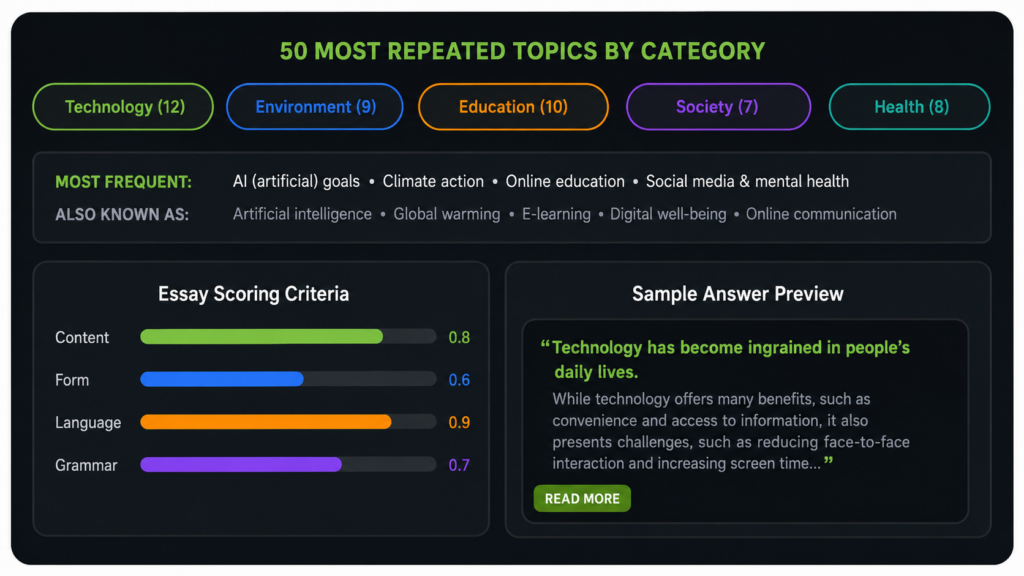
These 50 topics are organized into 7 categories. For each category, I have included the topics most frequently reported by students who took PTE in 2025–2026. Study them by category this lets you build reusable vocabulary and arguments that transfer across related prompts.
Category 1: Education (9 Topics)
| S.No | Essay Topic | Type |
|---|---|---|
| 1 | Some people believe that online education is more effective than traditional classroom learning. Do you agree or disagree? | Agree/Disagree |
| 2 | Universities should focus more on practical skills rather than theoretical knowledge. To what extent do you agree or disagree? | Agree/Disagree |
| 3 | In many countries, the cost of university education is rising. Should the government provide free education for all citizens? | Discuss |
| 4 | Some people argue that children should start learning a foreign language in primary school, while others believe it is better to start in secondary school. Discuss both views. | Both Views |
| 5 | The role of teachers has changed significantly due to technology. Some believe teachers will be replaced by technology in the future. Do you agree or disagree? | Agree/Disagree |
| 6 | Some people think that the education system should focus on preparing students for the workforce. Others believe education should be about broadening the mind. Discuss both views and give your opinion. | Both Views |
| 7 | Standardized testing is the best way to evaluate student performance. To what extent do you agree or disagree? | Agree/Disagree |
| 8 | Some experts believe that homework is an essential part of education, while others argue it places unnecessary pressure on students. Discuss both views. | Both Views |
| 9 | International students bring significant benefits to universities in their host countries. To what extent do you agree or disagree? | Agree/Disagree |
Category 2: Technology & AI (9 Topics)
| S.No | Essay Topic | Type |
|---|---|---|
| 10 | With the rise of artificial intelligence, many jobs will be replaced by machines. Is this a positive or negative development? | Positive/Negative |
| 11 | Social media has had a significant impact on the way people communicate. Do you think this impact has been largely positive or negative? | Positive/Negative |
| 12 | Some people believe that technology has made our lives more complicated rather than simpler. Do you agree or disagree? | Agree/Disagree |
| 13 | Governments should regulate the use of artificial intelligence to prevent misuse. To what extent do you agree or disagree? | Agree/Disagree |
| 14 | The increasing use of smartphones among children is a cause for concern. What are the problems associated with this, and what solutions can be proposed? | Problem/Solution |
| 15 | Some people believe that automation will create more jobs than it destroys, while others disagree. Discuss both views and give your opinion. | Both Views |
| 16 | The internet has made information freely available to everyone. Is this a positive or negative development for society? | Positive/Negative |
| 17 | Some people argue that digital surveillance by governments is necessary for national security, while others believe it violates personal privacy. Discuss both views. | Both Views |
| 18 | Virtual reality and augmented reality technologies will transform the way we learn and work. To what extent do you agree or disagree? | Agree/Disagree |
Category 3: Environment & Climate (7 Topics)
| S.No | Essay Topic | Type |
|---|---|---|
| 19 | Climate change is the greatest threat facing humanity today. Do you agree or disagree? | Agree/Disagree |
| 20 | Some people believe that individuals can do little to address environmental problems and that it is the responsibility of governments and large companies. Do you agree or disagree? | Agree/Disagree |
| 21 | The use of renewable energy sources should be made mandatory for all countries. To what extent do you agree or disagree? | Agree/Disagree |
| 22 | Many cities around the world are experiencing severe pollution. What are the causes of this problem, and what measures can be taken to address it? | Problem/Solution |
| 23 | Some people argue that economic development is more important than environmental protection. Discuss both views and give your opinion. | Both Views |
| 24 | Plastic waste has become a global crisis. What are the most effective ways to reduce plastic consumption? | Problem/Solution |
| 25 | Some people believe that space exploration is a waste of resources and that the money should be spent on solving problems on Earth. Do you agree or disagree? | Agree/Disagree |
Category 4: Health & Lifestyle (6 Topics)
| S.No. | Essay Topic | Type |
|---|---|---|
| 26 | In many countries, people are living longer than ever before. What are the causes and effects of this trend? | Cause/Effect |
| 27 | Some people believe that the government should be responsible for the health of its citizens, while others think individuals should take responsibility for their own health. Discuss both views. | Both Views |
| 28 | The increase in fast food consumption is leading to a rise in obesity and health problems. What measures can be taken to encourage healthier eating habits? | Problem/Solution |
| 29 | Mental health awareness has increased in recent years, but many people still do not seek help. What are the barriers to seeking mental health treatment, and how can they be overcome? | Problem/Solution |
| 30 | Some people argue that physical education should be a compulsory subject at all levels of schooling. Do you agree or disagree? | Agree/Disagree |
| 31 | The sedentary lifestyle caused by modern technology is one of the biggest health risks of the 21st century. To what extent do you agree or disagree? | Agree/Disagree |
Category 5: Society & Culture (6 Topics)
| S.No. | Essay Topic | Type |
|---|---|---|
| 32 | Globalization has led to the loss of cultural identity in many countries. Do you agree or disagree? | Agree/Disagree |
| 33 | Some people believe that immigration has a positive impact on the economy and culture of a country, while others believe it causes problems. Discuss both views. | Both Views |
| 34 | The gap between the rich and the poor is widening in many countries. What are the causes of this problem, and what solutions can be proposed? | Problem/Solution |
| 35 | In many societies, elderly people are no longer cared for by their families and are placed in nursing homes. Is this a positive or negative development? | Positive/Negative |
| 36 | Some people think that mass media, including television and newspapers, has a negative influence on society. Do you agree or disagree? | Agree/Disagree |
| 37 | Gender equality has improved in many parts of the world but there is still a long way to go. What further measures are needed to achieve full gender equality? | Problem/Solution |
Category 6: Government & Policy (6 Topics)
| S.NO. | Essay Topic | Type |
|---|---|---|
| 38 | Some people believe that the death penalty is an effective deterrent against serious crime, while others argue it is inhumane and should be abolished. Discuss both views. | Both Views |
| 39 | Governments should spend more money on public transportation to reduce traffic congestion and air pollution. To what extent do you agree or disagree? | Agree/Disagree |
| 40 | Some people argue that voting should be made compulsory in all democratic countries. Do you agree or disagree? | Agree/Disagree |
| 41 | The government should impose higher taxes on unhealthy food and use the revenue to subsidize fresh fruits and vegetables. To what extent do you agree or disagree? | Agree/Disagree |
| 42 | Some countries have introduced a ban on smoking in all public places. Do you think this is a justified policy? Discuss the advantages and disadvantages. | Advantages/Disadvantages |
| 43 | Foreign aid from wealthy nations to developing countries often does more harm than good. To what extent do you agree or disagree? | Agree/Disagree |
Category 7: Work & Economy (7 Topics)
| S.No. | Essay Topic | Type |
|---|---|---|
| 44 | Working from home has become increasingly common since the pandemic. Do you think remote work will become the norm, or will people return to traditional offices? | Discuss |
| 45 | Some people believe that a university degree is no longer necessary to have a successful career. Do you agree or disagree? | Agree/Disagree |
| 46 | The gig economy, where people work short-term contracts instead of permanent jobs, is growing rapidly. Is this a positive or negative development for workers? | Positive/Negative |
| 47 | Some people argue that the minimum wage should be raised significantly to reduce poverty. Others believe this would lead to job losses. Discuss both views. | Both Views |
| 48 | Many young people today change careers several times during their working lives. Is this a positive or negative trend? | Positive/Negative |
| 49 | Some people believe that large multinational companies have too much power in the global economy. Do you agree or disagree? | Agree/Disagree |
| 50 | Work-life balance is becoming increasingly difficult to achieve in modern society. What are the causes of this problem, and how can individuals and employers address it? | Problem/Solution |
Sample Essay 1: Education — Online vs. Classroom Learning
Topic: Some people believe that online education is more effective than traditional classroom learning. Do you agree or disagree?
Framework applied: Agree/Disagree → Context + Position introduction → Two supporting arguments → Concession & conclusion
The debate between online and traditional classroom education has intensified as digital learning platforms continue to evolve. While online education offers undeniable advantages in terms of accessibility and flexibility, I believe that traditional classroom learning remains more effective for most students due to the structured environment and interpersonal engagement it provides.
One of the primary strengths of classroom learning is the direct interaction between students and teachers. In a physical classroom, instructors can observe body language, identify confusion in real time, and adapt their teaching approach accordingly. Research from the National Bureau of Economic Research found that students in face-to-face settings scored significantly higher in comprehension tests compared to their online counterparts. This immediate feedback loop is difficult to replicate in virtual environments, where students often hesitate to ask questions or struggle with technical distractions.
Furthermore, classroom learning promotes collaborative skills and social development that are essential in the modern workforce. Group discussions, peer presentations, and team projects create opportunities for students to develop communication and problem-solving abilities in a way that asynchronous online forums cannot match. Employers consistently report that teamwork and interpersonal skills are among the most valued qualities in new graduates, skills that are best developed through in-person interaction.
In conclusion, while online education provides valuable flexibility for certain learners, traditional classroom settings remain superior for the majority due to their capacity for real-time engagement and social skill development. Educational institutions should integrate digital tools to enhance classroom learning rather than replace it entirely.
Word count: 258 words
| Criterion | Score | Why |
|---|---|---|
| Content | 3/3 | Directly addresses the prompt, takes a clear position, and stays on-topic throughout |
| Development, Structure & Coherence | 2/2 | Clear 4-paragraph structure, each paragraph has a distinct purpose, ideas flow logically |
| Form | 2/2 | 258 words — well within the 200–300 range |
| General Linguistic Range | 2/2 | Mix of simple and complex sentences, varied subordination, sophisticated phrasing |
| Grammar Usage & Mechanics | 2/2 | No grammatical errors, correct subject-verb agreement, proper punctuation throughout |
| Vocabulary Range | 2/2 | Topic-specific vocabulary (asynchronous, interpersonal, comprehension), no repetition |
| Spelling | 2/2 | No spelling errors, consistent spelling convention |
| Total | 15/15 | Full marks — demonstrates what the framework produces with genuine engagement |
Sample Essay 2: Technology — AI and Job Replacement
Topic: With the rise of artificial intelligence, many jobs will be replaced by machines. Is this a positive or negative development?
Framework applied: Positive/Negative → Context + nuanced position → Positive argument → Negative argument → Balanced conclusion
Artificial intelligence is transforming industries at an unprecedented pace, and the displacement of human workers by automated systems has become a pressing global concern. While this transition presents genuine risks, I believe the overall development is more positive than negative, provided that governments and institutions invest in workforce adaptation.
The primary benefit of AI-driven automation is its potential to eliminate repetitive, dangerous, and low-skill tasks, freeing human workers to focus on more creative and intellectually rewarding roles. Historical precedents support this view. The Industrial Revolution initially displaced millions of agricultural workers, yet it ultimately created far more jobs than it destroyed by giving rise to entirely new industries. Similarly, AI is already generating demand for data scientists, machine learning engineers, and AI ethics specialists roles that did not exist a decade ago. According to the World Economic Forum, automation is expected to create 97 million new positions globally by 2025, outpacing the 85 million it displaces.
However, the transition will not be painless for everyone. Workers in sectors such as manufacturing, transportation, and customer service face significant displacement without automatic pathways to new employment. The risk is particularly acute for older workers and those without access to retraining programs. Without deliberate policy intervention, AI-driven automation could deepen economic inequality rather than reduce it, concentrating wealth among technology owners while leaving displaced workers behind.
In conclusion, AI-driven job displacement is a largely positive development that will ultimately expand economic opportunity, but only if supported by proactive investment in education, reskilling programs, and social safety nets to ensure the benefits are broadly shared.
Word count: 262 words
| Criterion | Score | Why |
|---|---|---|
| Content | 3/3 | Addresses the prompt directly, covers both positive and negative aspects, clear position stated |
| Development, Structure & Coherence | 2/2 | Logical 4-paragraph progression, smooth transitions, balanced treatment of both sides |
| Form | 2/2 | 262 words — within the target range |
| General Linguistic Range | 2/2 | Complex sentence structures, conditional clauses, varied subordination patterns |
| Grammar Usage & Mechanics | 2/2 | Accurate grammar throughout, correct use of passive and active voice, no errors |
| Vocabulary Range | 2/2 | Sophisticated topic vocabulary (unprecedented, displacement, proactive, reskilling), no repetition |
| Spelling | 2/2 | No spelling errors |
| Total | 15/15 | Full marks — demonstrates balanced argument structure with specific evidence |
Sample Essay 3: Environment – Individual vs. Government Responsibility
Topic: Some people believe that individuals can do little to address environmental problems and that it is the responsibility of governments and large companies. Do you agree or disagree?
Framework applied: Agree/Disagree → Context + Position → Argument for shared responsibility → Argument for government/corporate leadership → Conclusion with recommendation
Environmental degradation has reached alarming levels, prompting debate about who bears the greatest responsibility for addressing it. While I acknowledge that governments and corporations hold more structural power, I disagree with the notion that individuals can do little. Meaningful environmental progress requires coordinated action at every level of society.
Individual actions, when adopted collectively, can produce substantial environmental impact. Consumer choices directly influence corporate behaviour. When millions of consumers reduce single-use plastic consumption, companies respond by developing sustainable packaging alternatives. The rapid growth of the plant-based food industry illustrates this dynamic. Global sales of plant-based products grew by 27 percent between 2020 and 2024, driven primarily by individual purchasing decisions rather than government mandates. Furthermore, individual advocacy and voting behaviour shape the political landscape that determines environmental policy. Citizens who prioritize environmental issues at the ballot box create incentives for governments to enact stronger regulations.
Nevertheless, individual effort alone is insufficient without systemic support from governments and large companies. Corporations account for over 70 percent of global greenhouse gas emissions, and only regulatory frameworks can compel meaningful reductions at that scale. Governments possess the authority to implement carbon pricing, enforce emission standards, and fund renewable energy infrastructure — interventions that no individual can replicate. The most effective approach combines bottom-up pressure from individuals with top-down regulation from institutions.
In conclusion, environmental responsibility is shared, not singular. Individuals can and do make meaningful contributions through their choices and advocacy, but lasting solutions require governments and corporations to implement systemic changes that individual actions alone cannot achieve.
Word count: 253 words
| Criterion | Score | Why |
|---|---|---|
| Content | 3/3 | Fully addresses both parts of the prompt — individual role AND government/corporate role — with a clear position |
| Development, Structure & Coherence | 2/2 | Each paragraph serves a distinct function, transitions are smooth, ideas build on each other |
| Form | 2/2 | 253 words — squarely in the optimal range |
| General Linguistic Range | 2/2 | Wide variety of sentence types, academic register, effective use of concession (While, Nevertheless) |
| Grammar Usage & Mechanics | 2/2 | Grammatically flawless, accurate complex structures, correct punctuation |
| Vocabulary Range | 2/2 | Strong topic vocabulary (degradation, systemic, regulatory frameworks, greenhouse gas emissions), precise word choice |
| Spelling | 2/2 | No spelling errors, consistent British spelling (behaviour, recognised) |
| Total | 15/15 | Full marks – demonstrates nuanced position with specific data and logical structure |
What Are the 5 Mistakes That Guarantee a Low Essay Score?
After reviewing over 10,000 student essays at Language Academy, these five mistakes are the most consistent predictors of low scores. Each one directly impacts specific scoring criteria, and eliminating them is the fastest path to improvement.
| Mistake | Criteria Affected | Points at Risk | How to Avoid It |
|---|---|---|---|
| 1. Not answering the actual question | Content | Up to 15 (entire essay = 0) | Underline the key instruction words (agree/disagree, discuss both, causes/solutions) before writing. Re-read the prompt after writing your introduction to confirm alignment. |
| 2. Writing outside the 200–300 word range | Form | 2 points (Form = 0) | Practice estimating word count. Aim for 250–280 words. Check the on-screen counter at the 15-minute mark. If under 200, expand your weakest paragraph. If over 300, trim your conclusion. |
| 3. Using a memorized template | Content, Development, Linguistic Range | Up to 7 points | Human raters detect templates. Use the Adaptive Framework instead — it gives you structure without fixed phrases. Every sentence should be written fresh for the specific topic. |
| 4. Writing one long paragraph with no structure | Development, Structure & Coherence | 2 points | Always use 4 paragraphs. Press Enter to create a new paragraph after your introduction, after each body paragraph, and before your conclusion. Visual structure matters to both AI and human raters. |
| 5. Spending all 20 minutes writing with no review | Grammar, Spelling | Up to 4 points | Stop writing at the 18-minute mark. Use the final 2 minutes to scan for spelling errors, subject-verb agreement issues, and missing punctuation. Two minutes of review typically catches 3–5 fixable errors. |
What Is Varun’s Exam-Day Essay Strategy?
This is the exact 20-minute strategy I use every time I take the PTE, and it is what I teach every student at Language Academy. It is designed to maximize your score under real exam pressure.
Minutes 0–2: Read and Plan
- Read the prompt twice. Underline the key instruction (agree/disagree, both views, problem/solution)
- Decide your position in 30 seconds — do not overthink this. Pick the side you can argue more easily
- Jot down 2 main points on your noteboard (one for each body paragraph) and 1 example or piece of evidence for each
Minutes 2–4: Write Your Introduction
- 1–2 sentences of context that shows you understand the topic
- 1 sentence stating your position clearly
- Target: 40–50 words. Do not exceed 60 words for the introduction
Minutes 4–10: Write Body Paragraph 1
- Topic sentence stating your first main point
- Explanation of why this point matters
- Specific example, data point, or real-world reference
- Link sentence connecting back to your thesis
- Target: 80–100 words
Minutes 10–16: Write Body Paragraph 2
- Same structure as Body 1, different main point
- Use a transition word or phrase to connect to the previous paragraph
- Target: 80–100 words
Minutes 16–18: Write Your Conclusion
- Paraphrase your position (do not copy your introduction)
- Add a forward-looking thought, recommendation, or broader implication
- Target: 30–40 words. Keep it tight
Minutes 18–20: Review
- Check the word counter — if under 200 or over 300, adjust immediately
- Scan for spelling errors, especially on common words (government, environment, technology, development)
- Check subject-verb agreement in your complex sentences
- Verify you have 4 visible paragraphs (press Enter if needed)

Frequently Asked Questions
- How is this guide different from the 70+ essay topics guide?
- Will I definitely see one of these 50 topics in my exam?
- How long do I have for the PTE essay?
- What happens if my essay is under 200 words or over 300 words?
- Do PTE essay templates still work in 2026?
- What PTE essay score do I need for 79+?
- Should I use British or American spelling?
- How many practice essays should I write before the exam?

The Language Academy is made up of experienced educators and language specialists dedicated to helping learners build confidence in communication. With a practical, student-focused approach, we share insights, tips, and resources designed to make language learning effective, engaging, and accessible for students at every level.