Choosing between PTE and IELTS is one of the biggest decisions you will make on your English proficiency journey. This data-driven comparison written by a 12x PTE perfect scorer covers the NEW July 2025 score conversion tables, section-by-section difficulty breakdowns, costs, and a five-question decision framework so you can pick the right test with confidence.
My Honest Take as a 12x PTE Perfect Scorer
I have scored 90 in PTE twelve times. I run LA Language Academy, where we have helped over 50,000 students prepare for PTE. So you might assume I will tell you PTE is the better test. I will not. The honest truth is that the “better” test depends entirely on you your strengths, your weaknesses, your personality, and your goals.
Start Your PTE Success Journey
Over years of coaching, I have watched students who could not break PTE 65 walk into IELTS and score a 7.5. I have also seen the reverse students stuck at IELTS 6.0 for years who hit PTE 79 within weeks. There is no universally easier exam. There is only the exam that is easier for you.
What I promise in this article is complete honesty. I will lay out the data, the score conversions (using the NEW July 2025 official Pearson concordance table), the difficulty breakdowns, and a decision framework. By the end, you will know exactly which test to take and why.
How Do PTE and IELTS Compare Side by Side?
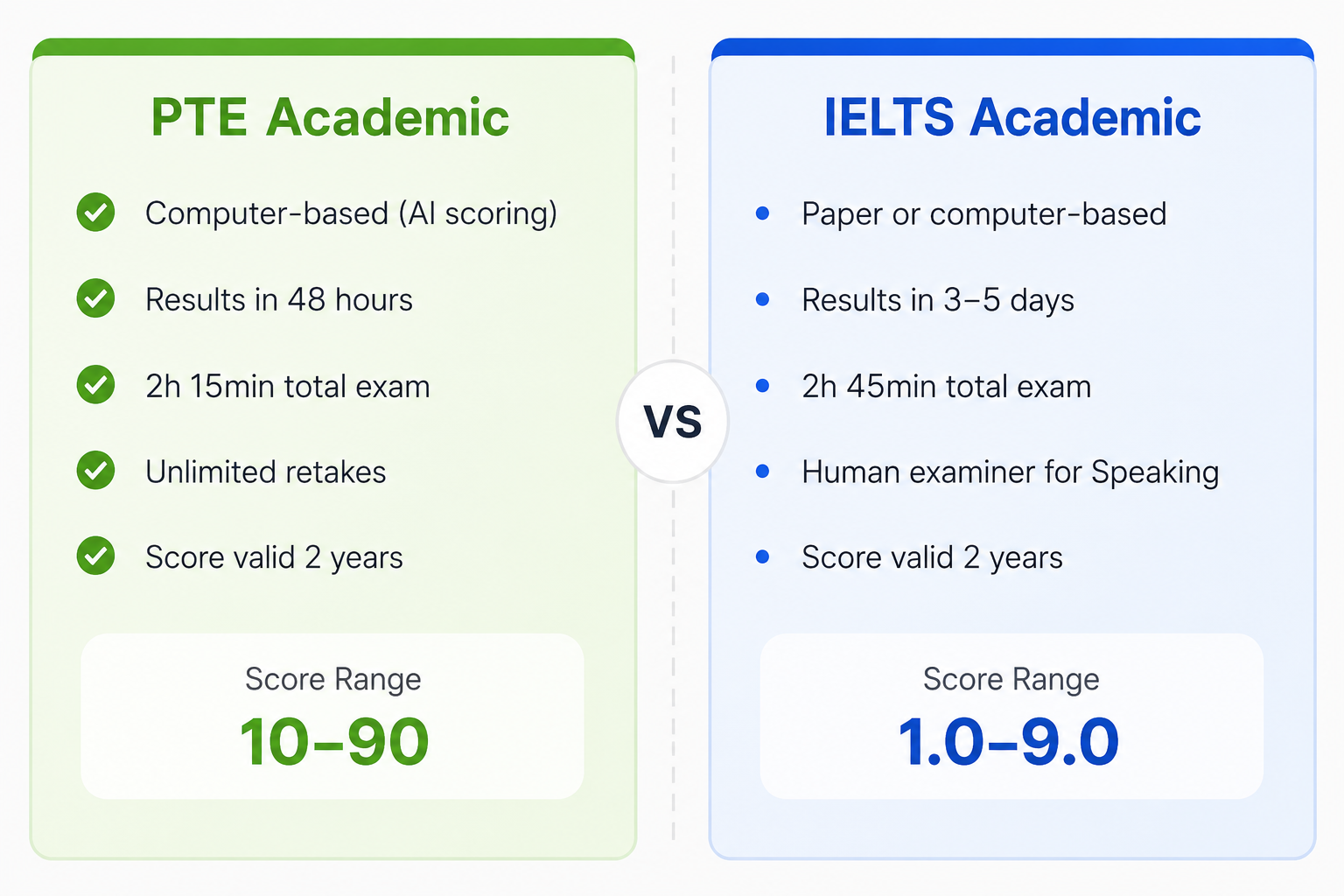
PTE Academic and IELTS Academic differ in format, scoring, timing, cost, and logistics. PTE is fully computer-based with AI scoring and faster results. IELTS offers both computer and paper options with human examiners. Here is every major difference in one table.
Confused About PTE Prep? Let’s Help!
| Feature | PTE Academic | IELTS (Academic) | Why It Matters |
|---|---|---|---|
| Test Format | 100% computer-based | Computer-based or paper-based | If you type slowly, IELTS paper may suit you better |
| Sections | 3 parts (Speaking & Writing combined, Reading, Listening) | 4 separate parts (Listening, Reading, Writing, Speaking) | PTE’s combined section requires more multi-tasking |
| Total Duration | ~2 hours 15 minutes, single sitting | ~2 hours 45 minutes; Speaking may be on a different day | PTE is faster and always completed in one session |
| Speaking Format | Speak into a microphone; scored by AI + human review | Face-to-face with a human examiner | This is the #1 factor most students base their decision on |
| Scoring System | 10–90 scale (granular, 1-point increments) | 1–9 bands (0.5 band increments) | PTE’s granular scoring means small improvements show up |
| Cost in Australia | ~AUD $410–$415 | ~AUD $490 | PTE saves you $75–$80 per attempt |
| Results Timeline | 1–2 business days | 3–13 days | PTE is significantly faster for urgent applications |
| Score Sends | Unlimited free score sends | Limited free sends; extras cost additional fees | PTE saves money if you are applying to multiple places |
| Global Acceptance | 3,000+ institutions worldwide | 12,500+ organizations worldwide | IELTS has broader acceptance, especially outside Australia |
| Test Availability | 365 days/year, multiple daily time slots | Limited dates, advance booking required | PTE offers far more flexibility for scheduling |
| Question Types | 22 question types, 65–75 questions per test | Fixed format with fewer, predictable task types | PTE requires more practice across varied question types |
At a glance, PTE wins on cost, speed, scheduling flexibility, and granular scoring. IELTS wins on global acceptance and format options. But the real decision should not be about logistics it should be about your personal strengths. The score conversion table below makes this much clearer.
How Do PTE Scores Convert to IELTS Bands? (NEW July 2025 Table)
In July 2025, Pearson released an updated official concordance table that maps PTE scores to IELTS bands not just for Overall scores, but for each communicative skill. This is critical because the Speaking and Writing conversions are very different from the Overall conversion. Use this table for all 2026 planning.
| IELTS Band | PTE Overall | PTE Listening | PTE Reading | PTE Speaking | PTE Writing |
|---|---|---|---|---|---|
| 4.5 | 24–30 | 26–32 | 29–35 | 14–23 | 17–28 |
| 5.0 | 31–38 | 33–39 | 36–41 | 24–38 | 29–40 |
| 5.5 | 39–46 | 40–46 | 42–47 | 39–53 | 41–50 |
| 6.0 | 47–54 | 47–52 | 48–53 | 54–65 | 51–59 |
| 6.5 | 55–62 | 53–57 | 54–58 | 66–75 | 60–68 |
| 7.0 | 63–70 | 58–63 | 59–64 | 76–82 | 69–76 |
| 7.5 | 71–78 | 64–68 | 65–69 | 83–87 | 77–84 |
| 8.0 | 79–85 | 69–74 | 70–74 | 88–89 | 85–89 |
| 8.5 | 86–89 | 75–80 | 75–80 | 90 | 90 |
| 9.0 | 90 | 81–90 | 81–90 | – | – |
Notice something? The PTE Speaking and Writing columns demand significantly higher scores than the Overall column to match the same IELTS band. This is one of the most important insights in this entire article, and I will break it down next.
Why Are PTE Speaking and Writing Scores So Much Higher?
The NEW July 2025 concordance reveals a gap that surprises most students: to match the same IELTS band, your PTE Speaking and Writing scores need to be much higher than your PTE Overall score. This changes how you should plan your preparation if you need minimum scores in each communicative skill.
| Skill | PTE Score Needed for IELTS 7.0 Equivalent | Difference from PTE Overall (63–70) |
|---|---|---|
| PTE Overall | 63–70 | Baseline |
| PTE Listening | 58–63 | 5–7 points lower |
| PTE Reading | 59–64 | 4–6 points lower |
| PTE Speaking | 76–82 | 12–13 points higher |
| PTE Writing | 69–76 | 6 points higher |
This means a student who can comfortably score PTE Overall 65 might still fall short on PTE Speaking (needing 76+) or PTE Writing (needing 69+). If your target requires minimum scores in each skill, you need to plan your preparation around the highest individual requirement not the Overall score.
Is PTE Better For You?
PTE Academic suits a specific type of test-taker. If you match several of the profiles below, PTE is likely your stronger option. This is not about which test is “easier” it is about which test format aligns with your natural strengths and circumstances.
PTE is better for you if:
- You are comfortable speaking to a computer. PTE Speaking is recorded via microphone with no human interaction. If you get nervous in face-to-face conversations or if your mind goes blank when someone watches you speak, PTE removes that pressure.
- You type quickly and accurately. PTE Writing tasks are typed. If you can type 40+ words per minute, you have more time to plan and edit your essays.
- You want fast results. PTE delivers scores in 1–2 business days. If you are on a tight visa deadline, this speed is a major advantage.
- You prefer flexible scheduling. PTE is available 365 days a year with multiple daily slots. You can book a test just days in advance.
- You are applying to Australian institutions or immigration. PTE is widely accepted across Australia, and PTE scores are valid for 3 years for immigration purposes (compared to 2 years for IELTS).
- You are good at pattern recognition and strategy. PTE has 22 question types, and each one has specific techniques that can boost your score. Strategy-oriented learners tend to improve faster in PTE.
- You want to save money. At ~AUD $410–$415 per attempt (vs. ~AUD $490 for IELTS), PTE is cheaper especially over multiple attempts.
Is IELTS Better For You?
IELTS Academic suits a different type of test-taker. If the profiles below sound like you, IELTS may give you a better score even if PTE is “technically” easier for some people. The best test is the one where YOUR skills translate into the highest score.
IELTS is better for you if:
- You are a confident conversationalist. IELTS Speaking is a face-to-face discussion with a human examiner. If you are naturally expressive, warm, and articulate in conversation, you can use body language, eye contact, and rapport to your advantage.
- You prefer handwriting over typing. Paper-based IELTS lets you write your essays by hand. If you think more clearly when writing on paper, this option can help.
- You want a more straightforward format. IELTS has fewer question types and a more predictable structure. If PTE’s 22 question types feel overwhelming, IELTS may feel less stressful.
- You need the broadest global acceptance. IELTS is recognized by 12,500+ organizations worldwide, compared to PTE’s 3,000+. If you are applying to universities in the UK, Canada, or Europe, always check acceptance first.
- You have a strong British/Australian English foundation. IELTS uses British English conventions. If your training has focused on British English spelling and vocabulary, this alignment can give you a slight edge.
- You struggle with PTE’s AI scoring. Some students find that PTE’s computer scoring does not reflect their actual ability — especially in Speaking. If you have taken PTE and your Speaking score feels unfairly low despite fluent English, IELTS may produce a more accurate result.
Speaking: PTE vs IELTS – Which Is Harder?
Speaking is where PTE and IELTS differ most dramatically. PTE requires you to speak into a microphone with strict time limits and AI-based scoring. IELTS gives you a face-to-face conversation with a human. Neither is universally harder it depends on your communication style.
| Aspect | PTE Speaking | IELTS Speaking |
|---|---|---|
| Format | Speak into microphone; AI + human scoring | Live conversation with human examiner |
| Time Pressure | Very strict; countdown timers, no second chances | More flexible; examiner can adjust pacing |
| Task Types | Read Aloud, Repeat Sentence, Describe Image, Re-tell Lecture, Answer Short Question | Part 1 (intro), Part 2 (long turn), Part 3 (discussion) |
| Recovery from Mistakes | Difficult – AI records everything, no do-overs | Easier – you can self-correct naturally in conversation |
| Nervousness Factor | Less social anxiety (no human watching) | More social anxiety (someone observing you) |
| Score Requirement (IELTS 7.0 equivalent) | PTE Speaking 76–82 | IELTS Speaking 7.0 |
Writing: PTE vs IELTS – Which Is Harder?
PTE Writing and IELTS Writing test different abilities. PTE combines writing tasks with speaking in one section and includes Summarize Written Text alongside the essay. IELTS separates writing completely and includes two distinct essay tasks. The scoring standards also differ significantly.
| Aspect | PTE Writing | IELTS Writing |
|---|---|---|
| Main Tasks | Summarize Written Text (1 sentence, 75 words max) + Essay (200–300 words) | Task 1 (report/letter, 150+ words) + Task 2 (essay, 250+ words) |
| Input Method | Typed on computer | Typed (computer) or handwritten (paper) |
| Scoring | AI-scored with human review | Human-scored by trained examiners |
| Score Requirement (IELTS 7.0 equivalent) | PTE Writing 69–76 | IELTS Writing 7.0 |
| Common Challenge | Summarize Written Text is a unique task that many students find tricky | IELTS Task 1 (describing data/charts) requires specific skills |
IELTS Writing is famously difficult to score 7.0+ in many students get stuck at 6.5 for months. PTE Writing, on the other hand, is more formulaic and strategy-driven, but the July 2025 concordance shows you need PTE Writing 69–76 to match IELTS 7.0. That is 6+ points above the Overall requirement. Neither is easy at higher levels.
Reading: PTE vs IELTS – Which Is Harder?
Reading is the section where PTE and IELTS are most similar in difficulty. Both test comprehension of academic texts. The main differences are in question types and time pressure. For most students, Reading performance is comparable across both tests.
| Aspect | PTE Reading | IELTS Reading |
|---|---|---|
| Text Types | Academic passages, shorter variety | 3 long academic passages |
| Question Types | Multiple choice, Re-order Paragraphs, Fill in the Blanks (reading & R/W) | True/False/Not Given, Matching, Short Answer, Sentence Completion |
| Score Requirement (IELTS 7.0 equivalent) | PTE Reading 59–64 | IELTS Reading 7.0 |
| Unique Challenge | Re-order Paragraphs is a PTE-only task that requires logic skills | True/False/Not Given often confuses students who overthink |
The July 2025 concordance shows PTE Reading 59–64 maps to IELTS 7.0 which is actually lower than the PTE Overall requirement of 63–70 for the same band. Reading is generally the least problematic skill in terms of score gaps.
Listening: PTE vs IELTS — Which Is Harder?
Listening is tested differently in PTE and IELTS, but both require strong concentration and note-taking. PTE Listening includes unique tasks like Summarize Spoken Text and Write from Dictation, while IELTS Listening follows a more traditional format with recordings and questions.
| Aspect | PTE Listening | IELTS Listening |
|---|---|---|
| Format | Audio plays once; tasks include Summarize Spoken Text, MCQ, Fill in Blanks, Highlight Correct Summary, Write from Dictation | 4 sections of increasing difficulty; audio plays once; 40 questions |
| Cross-skill Impact | High — Listening tasks contribute to Writing and Reading scores too | Low — Listening is scored independently |
| Score Requirement (IELTS 7.0 equivalent) | PTE Listening 58–63 | IELTS Listening 7.0 |
| Unique Challenge | Write from Dictation is high-stakes — each word matters for scoring | Sections 3 and 4 use academic vocabulary that can be very dense |
PTE Listening 58–63 maps to IELTS 7.0 again, lower than the PTE Overall requirement. Listening is also generally achievable for most students with focused practice, especially Write from Dictation, which has an outsized impact on your overall PTE score.
The Truth About “PTE Is Easier”
You will hear this claim everywhere. Students say it. Coaching centres say it. Even some migration agents say it. But the reality is more nuanced. PTE is not universally easier than IELTS it is easier for specific types of students, and harder for others.
When PTE Feels Easier
- You are a fast typist and comfortable with computers
- You get anxious speaking to humans but are fine with a microphone
- You are good at learning specific strategies for each question type
- You have a clear, consistent pronunciation (the AI rewards consistency)
- You want to retake quickly if you fall short — PTE lets you rebook within days
When IELTS Feels Easier
- You are a natural conversationalist who thrives in human interaction
- You have an accent that PTE’s AI sometimes misjudges
- You prefer fewer question types and a more predictable format
- You are better at handwriting than typing
- You struggle with PTE’s strict time limits and automatic microphone cutoffs
The July 2025 concordance data adds another layer to this. At the IELTS 7.0 level, PTE’s Overall requirement (63–70) seems “lower” than what many students expect. But the Speaking requirement (76–82) and Writing requirement (69–76) are substantially higher. So while PTE might feel easier overall, individual skill requirements can be more demanding.
My honest advice: if you are unsure, take a full practice test of each. Compare your scores. The data will tell you which test format rewards your strengths.
Which Test Costs Less – Including Retakes?
PTE is cheaper per attempt, and the savings compound over multiple retakes. Below is a realistic cost comparison for students in Australia, including the hidden costs that most people forget about.
| Cost Factor | PTE Academic | IELTS Academic |
|---|---|---|
| Test Fee (1 attempt) | ~AUD $410–$415 | ~AUD $490 |
| 2 Attempts | ~AUD $820–$830 | ~AUD $980 |
| 3 Attempts | ~AUD $1,230–$1,245 | ~AUD $1,470 |
| Score Sends | Unlimited free | Limited free; extras ~AUD $20+ each |
| Rescheduling | Free if done 48+ hours before test | Varies; may incur fees |
| Savings After 3 Attempts | PTE saves ~AUD $225–$240 over 3 attempts | |
If you are planning for the possibility of retakes (which is realistic many students need 2–3 attempts), PTE’s lower cost and faster rebooking make it the more budget-friendly choice. You also get results in 1–2 days, so you spend less time waiting and more time acting on feedback.
For Australian Immigration: Does It Matter Which Test You Choose?
For Australian visa applications and skilled migration, both PTE and IELTS are fully accepted. The Department of Home Affairs recognizes PTE Academic, IELTS Academic, IELTS General Training, and several other tests. Your choice should be based on which test gives you the best score not on which one immigration prefers, because they do not prefer one over the other.
| English Level | Points | PTE Requirement | IELTS Requirement |
|---|---|---|---|
| Superior English | 20 points | PTE 79+ (each skill) | IELTS 8.0+ (each band) |
| Proficient English | 10 points | PTE 65+ (each skill) | IELTS 7.0+ (each band) |
| Competent English | 0 points | PTE 50+ (each skill) | IELTS 6.0+ (each band) |
How Do You Decide? Answer These 5 Questions
After reviewing all the data, formats, and score conversions, the decision comes down to five personal questions. Answer them honestly and the right test will become obvious. Do not choose based on what your friend did or what a random forum post said choose based on YOUR profile.
Question 1: How do you perform under strict time pressure?
PTE has tight countdowns and automatic cutoffs. If you freeze when the clock ticks, IELTS gives you slightly more breathing room (especially in Speaking). If time pressure motivates you, PTE’s pace can work in your favour.
Question 2: Are you more comfortable speaking to a machine or a human?
This is the single biggest differentiator. If speaking to a microphone feels unnatural, go IELTS. If human eye contact makes you nervous, go PTE. Take a practice test of each to find out — do not just guess.
Question 3: Do you need minimum scores in each skill (not just Overall)?
If yes, study the July 2025 concordance table carefully. PTE Speaking requires 76–82 to match IELTS 7.0, and PTE Writing requires 69–76. If Speaking or Writing is your weak spot, IELTS might be the smarter play — because IELTS does not have the same inflated skill-level requirements.
Question 4: How quickly do you need your results?
PTE delivers in 1–2 business days. IELTS takes 3–13 days. If your visa, admission, or job deadline is tight, PTE’s speed is a genuine advantage.
Question 5: Where are you applying?
For Australian immigration and universities — both tests are equally accepted. For UK immigration — check the latest UKVI requirements (IELTS for UKVI is often required). For Canada, the US, or Europe — IELTS generally has broader acceptance, but PTE is growing. Always verify acceptance with your specific institution.
Frequently Asked Questions
- Is PTE easier than IELTS?
- Should I take PTE or IELTS for Australia?
- Can I combine PTE and IELTS scores?
- Which test is cheaper – PTE or IELTS?
- How do PTE scores convert to IELTS bands?
- Is PTE accepted in the UK?
- How long are PTE and IELTS scores valid?
- What if my PTE Speaking score is much lower than my Overall score?

The Language Academy is made up of experienced educators and language specialists dedicated to helping learners build confidence in communication. With a practical, student-focused approach, we share insights, tips, and resources designed to make language learning effective, engaging, and accessible for students at every level.