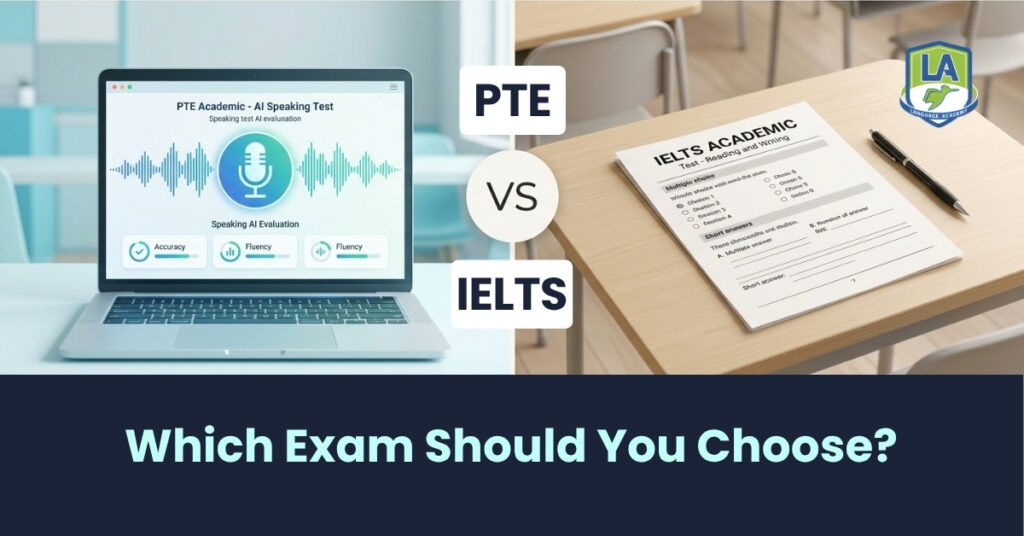
Quick Answer: Choose PTE if you prefer a computer-based test, want faster results, and are comfortable typing and speaking into a microphone. Choose IELTS if you are confident in face-to-face communication, prefer a traditional exam format, and feel more comfortable being evaluated by a human examiner.
If you are planning to study, work, or migrate to countries like Australia, Canada, the UK, or the USA, proving your English proficiency is not optional. It is a mandatory step that directly impacts your admission, visa approval, and even job opportunities. PTE and IELTS are the two most compared options for both visa migration and academic admission.
However, choosing one is difficult, and obviously, you cannot take both. So, which one is best, PTE or IELTS?
Start Your PTE Success Journey
Some find PTE easier because it is computer-based and gives fast results. Another says IELTS is more accepted and safer. Don’t follow others’ preferences because a wrong choice can cost you time, money, and sometimes even your target score. We are here to remove your confusion, help you understand the difference between PTE and IELTS, and confidently decide which test suits your strengths, timeline, and goals.
Know the Basics of PTE and IELTS
What is PTE?
PTE stands for Pearson Test of English. It is conducted by Pearson and is a fully computer-based English proficiency test. Every part of the exam, including speaking, is done on a computer. You speak into a microphone, type your answers, and your responses are evaluated using AI-based scoring systems.
PTE is designed to test real-life English usage. It focuses heavily on integrated tasks, where you combine skills such as listening and speaking, or reading and writing. Because of its digital nature, it is known for faster results and standardised evaluation.
Confused About PTE Prep? Let’s Help!
What is IELTS?
IELTS stands for International English Language Testing System. It is jointly conducted by the British Council, IDP, and Cambridge. Unlike PTE, IELTS offers both paper-based and computer-based formats.
The key difference lies in the speaking section, where you interact face-to-face with an examiner. IELTS has been around longer and is widely trusted across institutions and immigration authorities. It has a traditional exam structure and is evaluated by a human examiner.
What Is the Difference Between PTE and IELTS
This table gives you a quick snapshot, but your decision should go deeper than just surface-level differences.
|
Feature |
PTE |
IELTS |
|
Format |
Fully computer-based | Paper-based or computer-based |
|
Duration |
~2 hours |
~2 hours 45 minutes |
|
Scoring |
10–90 scale | Band score 0–9 |
| Results | 24–48 hours |
3–13 days |
|
Evaluation |
AI-based |
Human examiners |
| Speaking | Computer recorded |
Face-to-face |
What is the Test Format of Both Exams
PTE Exam Structure
PTE combines multiple skills into fewer sections. There are three main parts: Speaking & Writing, Reading, and Listening.
- The Speaking & Writing section: You have to listen to a lecture and then summarise it, or read a passage and respond verbally. This section has tasks like repeating a sentence, describing an image, and writing an essay, which require quick thinking and structured responses.
- The Reading section: It includes tasks such as multiple choice questions, reordering paragraphs, and fill-in-the-blank. The Listening section tests your ability to understand spoken English through tasks like summarising spoken text and identifying missing words.
The PTE task format is good for those comfortable with multitasking under time pressure.
IELTS Exam Structure
Listening, Reading, Writing, and Speaking are tested separately in IELTS.
- The Listening section: It includes recordings of conversations and monologues. The Reading section involves passages with different question types. The Writing section consists of two tasks, including essay writing.
- The Speaking section: This test is face-to-face with an examiner, where you give a short introduction, complete a cue card task, and have a discussion. Students usually get nervous in this section.
However, IELTS follows a linear structure, which some students find easier to manage compared to PTE’s integrated tasks.
How the Scoring Happens in Both the Exams
PTE Score Between 10-90
Here, you can get a lower score of 10 and a higher one upto 90. Instead of a human examiner, an AI gives you a score in the exam. Each response is analysed based on multiple parameters, including fluency, pronunciation, grammar, and vocabulary.
The biggest advantage is speed and predictability. If your performance improves, your score reflects it clearly without subjective variation.
IELTS Score Between 0-9
IELTS uses a band score from 0 to 9. Each section receives an individual band score, and the overall score is an average of all sections.
Here, a human examiner checks the speaking and writing test, which introduces a level of subjectivity. If you are good at communication, you can score high.
Which One Is Easier: PTE Vs IELTS
Honestly, neither is. The difficulty depends entirely on your strengths. If you are comfortable typing quickly and working on a computer, PTE may feel easier. Its structured scoring system rewards accuracy and consistency. If you prefer natural communication and can express ideas confidently in person, IELTS may suit you better. Accent understanding also plays a role. PTE includes a mix of global accents in listening tasks, while IELTS focuses more on British and Australian accents.
Speaking Section Comparison
PTE requires you to speak into a microphone. Your responses are recorded and evaluated by AI. This eliminates the pressure of facing an examiner but requires clarity, fluency, and confidence without human interaction. IELTS involves a face-to-face interview. You interact with an examiner who may ask follow-up questions. This format feels more conversational but can be stressful for shy candidates. If you tend to get nervous in interviews, PTE might be a better choice. If you express yourself better in real conversations, IELTS could work in your favour.
Writing Section Comparison
In PTE, all writing tasks are typed. This is an advantage if you are a fast and accurate typist. The time pressure is higher, and tasks are often integrated with reading or listening. In IELTS, you can choose between paper-based and computer-based formats. Writing involves structured essays and reports. If you are comfortable organising ideas in a traditional format, IELTS may feel more manageable. Evaluation also differs. PTE focuses on measurable parameters, while IELTS writing is judged by human examiners based on coherence, task response, and language use.
Results and Retake Options
PTE is known for its fast results, usually within 24 to 48 hours. This makes it ideal for students with tight deadlines. You can also retake the test quickly if needed. To increase your chances of getting higher marks, practice free PTE mock tests with an AI scoring system. IELTS results can come within 3 or 13 days, depending on the format. Though you can retake the exam, scheduling may take more time.
If your application deadlines are close, PTE offers a clear advantage.
How to Prepare for IELTS and PTE
If you want a high score like 65, 79 or above, random practice is not enough. You need structured preparation, regular mock tests, and clear strategies for each section. Self-study only if you can be consistent and disciplined, but you may struggle to identify mistakes and improve quickly without expert feedback.
LA Language Academy offers structured guidance for both PTE and IELTS preparation. Our real exam-based mock tests and personalised feedback help you learn what and how to improve. We have video courses and comprehensive study materials with a question bank based on the latest exam pattern to help you prepare better.
Which Exam Is Accepted Worldwide
Although both are widely accepted exams, IELTS is recognised by more than 12000 organisations in more than 150 countries. PTE, on the other hand, is accepted by over 3500 organisations in Australia, the UK, and NZ. The USA also recognise both tests, although specific visa categories may have preferences.
Before choosing, always check the requirements of your university or immigration pathway. In most cases, both tests are equally valid.
Which Is Cheap: PTE or IELTS
The exam cost depends on your location. If you are giving a test in Australia, the cost is $490 AUD (including 10% tax) for both PTE Academic and PTE Core. The PTE exam in India costs ₹18900 INR (including 18% tax) and $220.00 USD in Nepal.
On the other hand, the IELTS exam fee in 2026 varies depending on the test type.
|
IELTS Test |
Exam Fee |
|
Academic and General Training |
$490 AUD |
| IELTS for UKVI (Academic and General Training) |
$505 AUD |
| Life Skills |
$390 |
| IELTS One Skill Retake |
$310 |
The exam fee also changes if you are taking the test from regional Australia. But the good thing is, there is no late fee. The charges may increase if you take multiple attempts. So, attempt only when you are confident in your preparation.
Availability & Test Dates
PTE offers flexible scheduling with test slots available almost daily in many locations. This makes it easier to book a test at your convenience. IELTS has fixed test dates, which may be limited in some areas. While availability has improved, it is still less flexible compared to PTE.
If you need flexibility, PTE is the better option.
Who Should Choose PTE?
PTE is ideal for students who prefer a computer-based exam environment. If you are comfortable with technology, can type quickly, and want fast results, PTE aligns well with your needs.
It also suits those who want to avoid the variability of human evaluation.
Who Should Choose IELTS?
IELTS is better suited for students who are comfortable with human interaction. If you perform well in interviews and prefer a traditional exam format, IELTS can be a strong choice.
It is also a good option if you prefer writing on paper or trust a human evaluation system.
Expert Tips to Choose the Right Test
Start by taking a mock test for PTE and IELTS to understand how well you are prepared and where you need improvement. Identify your strengths. If you are strong in structured tasks and typing, lean towards PTE. If you are confident in communication and interviews, consider IELTS. Check the requirements of your target university or visa. While both tests are widely accepted, specific programmes may have preferences.
Finally, consider your timeline. If you need results quickly, PTE offers a practical advantage.
Final Verdict
PTE is faster, more flexible, and technology-driven. IELTS is traditional, widely recognised, and human-centric. Your decision should not be based on what others say is easier. It should be based on where you can perform your best. If you are still unsure, the smartest next step is to take a diagnostic mock test for both exams. This removes guesswork and shows you exactly where you stand. Focus your preparation based on your chosen test, build strategies around your weak areas, and practise consistently.
If you need guidance, personalised feedback, or a structured preparation plan, LA Language Academy experts are ready to help you and provide the right learning path for you.
FAQs-
1. Is PTE easier than IELTS?
No test is universally easier. PTE suits students comfortable with computers and typing, while IELTS suits those confident in face-to-face communication.
2. Is PTE more difficult?
The difficulty level has not increased significantly. However, scoring can feel stricter due to AI evaluation and updated question patterns.
3. Are IELTS and PTE the same?
PTE is fully computer-based, with AI scoring and faster results, while IELTS includes human evaluation and a face-to-face speaking test, and offers both paper and computer formats.
4. Which exam is best, IELTS or PTE?
The best exam depends on your strengths, comfort level, and timeline. Neither is better universally.
5. What is 5.5 IELTS equivalent to PTE?
An IELTS score of 5.5 is roughly equivalent to a PTE score of around 42–50.


The Language Academy is made up of experienced educators and language specialists dedicated to helping learners build confidence in communication. With a practical, student-focused approach, we share insights, tips, and resources designed to make language learning effective, engaging, and accessible for students at every level.