For most students, the confusing part about PTE is not the exam itself. It is understanding what the scores actually mean.
A student scoring 58 may still get admission into a university, while another student with 79 may be aiming for Australian PR points. The same exam serves different purposes, which is why understanding the PTE score chart in 2026 properly is important before setting a target score.
What Is the PTE Score Chart?
The PTE score chart is the official scoring scale used in the Pearson Test of English Academic. The score is calculated on a scale of 10 to 90 and measures your English proficiency across Speaking, Writing, Reading, and Listening. Your final result includes:
Start Your PTE Success Journey
- An overall score
- Individual communicative skill scores
- Performance across integrated tasks that affect multiple modules together
Unlike traditional exams, the overall PTE score is not simply an average of the four sections. Some question types contribute to more than one skill simultaneously, which is why certain tasks have a much larger impact on the final result.
Understanding the PTE Score Chart 2026
The meaning of a PTE score chart depends entirely on your purpose. Universities, immigration authorities, and professional bodies all use different score benchmarks.
Here is how PTE scores are generally interpreted in 2026:
Confused About PTE Prep? Let’s Help!
|
PTE Score |
English Proficiency Level | Common Use |
| 85–90 | Expert |
Competitive scholarships, top-ranked universities, and professional licensing |
|
76–84 |
Very Good | Strong postgraduate admissions and high PR competitiveness |
| 65–75 | Good |
Master’s programs and skilled migration pathways |
|
50–64 |
Competent | Bachelor’s degrees and diploma admissions |
| 36–49 | Functional |
Foundation and pathway programs |
|
Below 36 |
Limited |
Usually insufficient for academic or migration purposes |
A score of 65 is considered good for admission to many universities, but immigration systems often reward scores much higher than that. This is why students preparing for PR usually target 79+, while university applicants may only need 58–65.
How PTE Scores Are Actually Calculated
Your PTE score chart does not include the number of correct and incorrect answers. The scoring system also checks how effectively you communicate in English.
In other words, your score is influenced by:
- Pronunciation clarity
- Oral fluency
- Grammar accuracy
- Vocabulary usage
- Spelling
- Sentence structure
- Content relevance
This is especially important in speaking tasks. A student may speak correct English but still lose marks because of unnatural pauses, robotic delivery, unclear pronunciation, or memorised responses.
Another reason the PTE scoring system feels complicated is that many tasks are integrated into a single score. That means one question can affect multiple modules together.
For example:
|
Question Type |
Skills Affected |
| Read Aloud |
Speaking + Reading |
|
Repeat Sentence |
Listening + Speaking |
| Retell Lecture |
Listening + Speaking |
|
Summarise Spoken Text |
Listening + Writing |
| Write From Dictation |
Listening + Writing |
So, if you score less in tasks like Repeat Sentence or Write From Dictation, your overall PTE score would be less too.
What Is Considered a Good PTE Score in 2026?
There is no universal “good score” in PTE. A good score is simply the score that meets your academic, visa, or immigration requirements.
What Are the PTE Score Requirements for Universities
- Top-tier universities: 70+
- Mid-tier universities: 50-60+
The PTE score requirements for universities also vary by institution and course type. Courses involving communication-heavy professions generally require stronger English proficiency. Nursing, medicine, teaching, law, and psychology often require higher Speaking and Writing scores because communication accuracy is essential to professional practice.
Meanwhile, courses like IT or business studies may have comparatively lower sectional requirements.
For most universities in 2026:
- Diploma and pathway programs: 36-50+
- Bachelor courses: 51–60
- Postgraduate courses: 57–67
- Competitive: 65-79+
However, universities are now focusing more on sectional scores than on the overall result.
For example, a university may ask for an overall score of 65 and no communicative skill below 58. This means a student with a 72 in speaking, 68 in reading, 66 in listening, and 54 in writing may still fail to meet the admission requirement despite achieving the overall target.
This “no band below” rule applies across universities in Australia, the UK, Canada, and New Zealand.
What Is the Good PTE Score for Immigration in 2026
For migration applicants, English proficiency directly affects visa eligibility and PR competitiveness. The required PTE score for immigration in 2026 depends on:
- Country
- Visa category
- Skilled migration stream
- PR points system
Australia use PTE scores extensively for:
- Student visas
- Skilled migration
- Permanent residency pathways
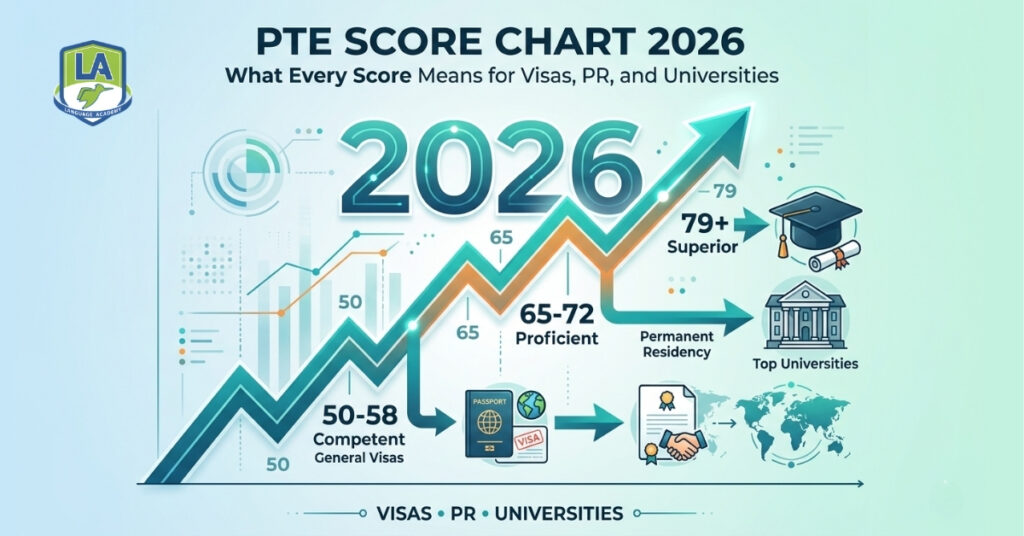
In Australian migration systems, English scores are generally classified as:
|
PTE Score |
English Level |
| 50 |
Competent English |
|
65 |
Proficient English |
| 79 |
Superior English |
A score of 79 in each communicative skill is especially important because it is commonly associated with maximum English language points in Australian PR systems. Canada has also expanded PTE acceptance through PTE Core for immigration pathways.
PTE Academic vs PTE Core Score Chart
One of the most common mistakes students make is booking the wrong exam. PTE Academic and PTE Core serve different purposes.
The PTE Academic score chart is mainly accepted for:
- University admissions
- Student visas
- Professional registration
The PTE Core score chart is primarily useful for:
- Canadian immigration
- Work-related migration pathways
- PR applications
Always verify which version is accepted by your university or immigration authority.
The List of PTE Score Accepted Countries
The list of countries accepting PTE scores continues to grow every year.
PTE Academic is widely accepted in:
- Australia
- Canada
- United Kingdom
- New Zealand
- United States
- Ireland
These countries use PTE scores for a combination of:
- Higher education admissions
- Visa processing
- Migration pathways
- Professional licensing
What Is the Validity of the PTE Academic Score
The validity of the PTE Academic score is generally 2 years from the exam date.
Most universities and visa authorities follow this timeline. However, some migration authorities may apply different rules depending on the visa stream.
Is the PTE Score Calculator Accurate?
Most students rely on a PTE score calculator during mock tests to estimate their score. Though it is a good prediction tool, it is not reliable. The real scoring system gives the weighted average rather than a simple average of the tasks.
Instead, use PTE mock tests from reputable platforms, such as Language Academy, that follow the PTE exam’s AI scoring system.
Use the PTE score calculator only to improve your performance. Also, treat the score as a range, not a number that you will achieve in the exam.
PTE Score vs IELTS Comparison
Many students compare PTE with IELTS before applying to universities. Here is how the PTE score range compares with the IELTS score band:
|
IELTS Band |
PTE Score |
|
5.0 |
31–38 |
| 5.5 |
39–46 |
|
6.0 |
47–54 |
| 6.5 |
55–62 |
|
7.0 |
63–70 |
| 7.5 |
71–78 |
|
8.0 |
79–85 |
| 8.5 |
86–89 |
|
9.0 |
90 |
It will help you understand the IELTS and PTE score requirements of universities. For example, if a university requires IELTS 6.5, the equivalent PTE score is usually 58–65, depending on the course.
What’s New in the PTE Score Chart in 2026
There are a few changes in the PTE score chart in 2026. However, the scoring scale remains 10–90 points.
- Hybrid Scoring System
The exam now uses a stronger hybrid evaluation model where AI assesses fluency, pronunciation, grammar, and spelling, while human reviewers monitor content quality and response relevance.
- Stricter Detection of Memorised Templates
Responses that sound robotic, repetitive, or overly memorised are more likely to lose marks, especially in speaking tasks.
- More Detailed Score Reports
PTE score reports now provide clearer diagnostic feedback on enabling skills such as pronunciation, oral fluency, grammar, vocabulary, and spelling.
- Higher Weightage for Read Aloud
The Read Aloud task now contributes much more heavily to the Speaking module than before, making pronunciation and pacing more important than before.
- Changes in Fill-in-the-Blanks
Reading & Writing Fill in the Blanks (dropdown type) impacts only the reading task.
- New Question Types
This year, two new tasks have been added to the exam:
Summarise Group Discussion: It contributes to Listening and Speaking.
Respond to a Situation: It evaluates practical communication, tone, and contextual understanding.
- Greater Focus on Real Communication
The updated exam now gives priority to:
- Natural English usage
- Context awareness
- Professional tone
- Real-world communication skills
Updated Nursing Requirements in Australia
For nursing and healthcare pathways in Australia, speaking requirements increased to 76, while writing requirements increased to 60.
Final Thoughts
Understanding the PTE score chart in 2026 is not about memorising how much to score in each module. It is about understanding which score is actually relevant for your goal.
A student applying for a diploma course does not need the same score as someone targeting Australian PR or a competitive postgraduate program. So, before preparing for the exam, always check your:
- Overall score requirements
- Sectional score cut-offs
- Accepted PTE version
- Country-specific immigration rules
A focused preparation strategy to achieve your exact target score is far more effective than simply aiming for the highest score.

Frequently Asked Questions
- How much to score in PTE in 2026?
If your goal is to study in universities, score between 58 and 65 for bachelor’s and master’s programs. For Australian PR pathways, target 79+ in each communicative skill to get more migration points.
- Which PTE tasks carry the highest scoring weight?
Tasks like Repeat Sentence, Read Aloud, and Write From Dictation usually have the greatest impact because they involve multiple communicative skills. Scoring high in these tasks can improve the overall score.
- How long is the PTE Academic score valid?
Only for 2 years from the test date for university admissions and most visa applications. Some immigration programs may apply separate validity conditions depending on the country and visa category.
- Which countries accept PTE Academic scores in 2026?
PTE Academic is accepted in countries such as Australia, Canada, the United Kingdom, New Zealand, the United States, and Ireland for university admissions, student visas, skilled migration, and professional registration.

The Language Academy is made up of experienced educators and language specialists dedicated to helping learners build confidence in communication. With a practical, student-focused approach, we share insights, tips, and resources designed to make language learning effective, engaging, and accessible for students at every level.