50,000+
Successful Students
95%
AI Scoring Accuracy
29,000+
Practiced Questions

Wondering where you stand before taking the PTE? Or trying to figure out if your mock test scores are good enough for your visa application or university admission?
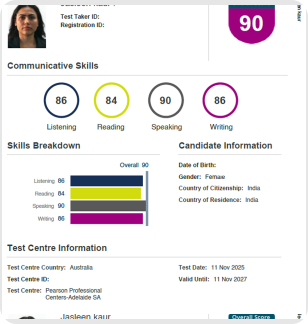
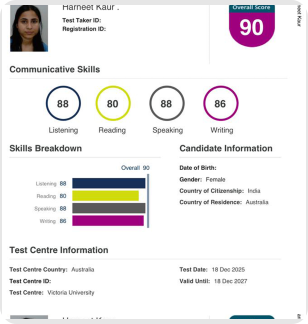
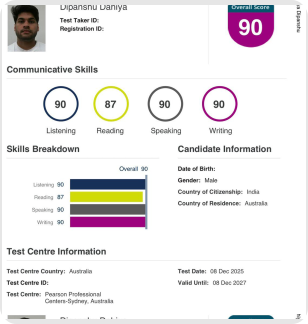
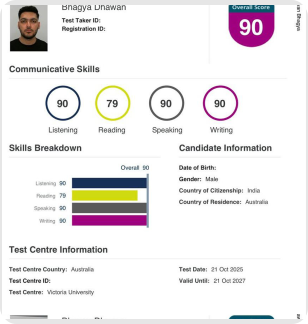
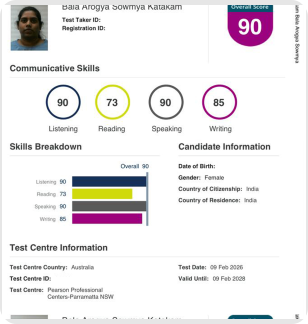
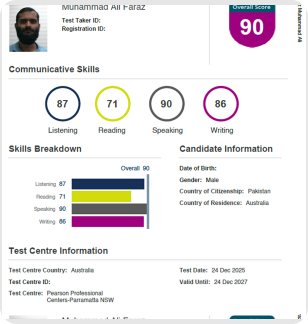
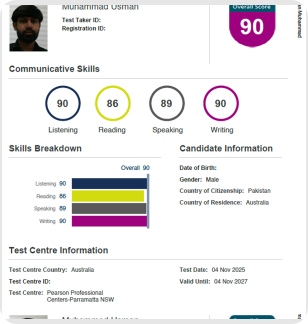
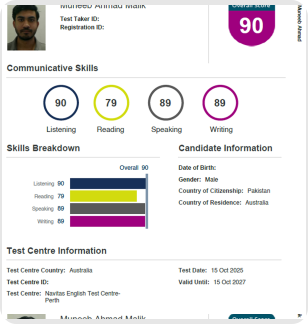
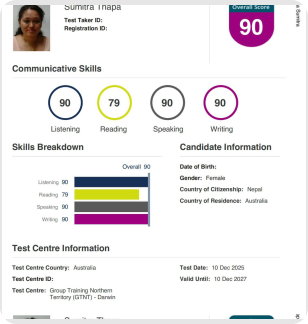
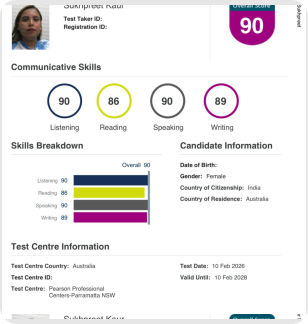
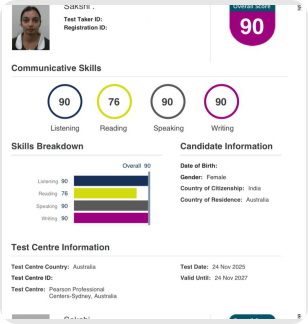
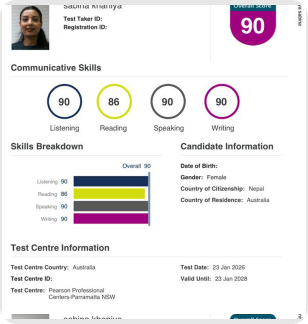
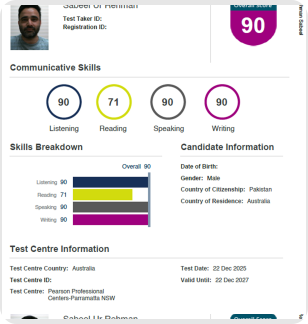
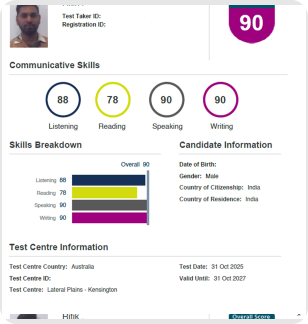
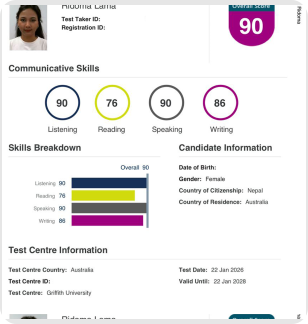
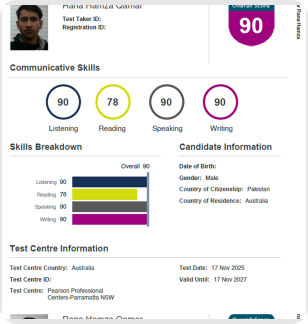
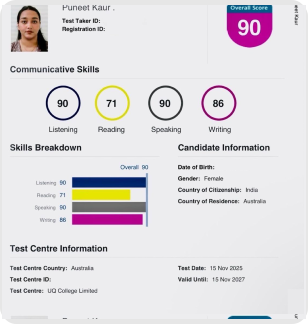
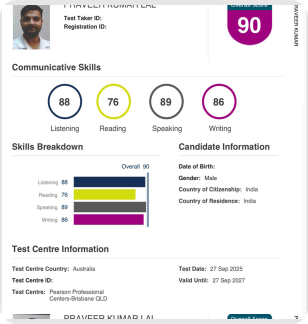
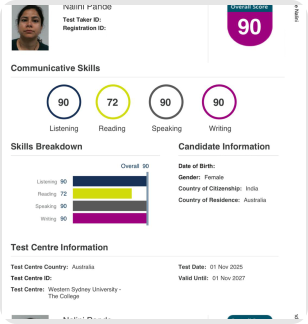
Our free PTE score calculator helps you estimate your overall PTE Academic score based on your individual section scores — so you know exactly where you are and what you still need to work on.
PTE scoring isn’t as straightforward as averaging your four section scores. The system uses an integrated scoring model where some tasks
contribute to multiple skill areas simultaneously. That’s why two students with seemingly similar section scores can end up with different overall results. Our calculator takes this into account, giving you a more accurate picture of your likely overall score.

The official alignment between PTE Academic scores and IELTS bands, per the Pearson PTE Academic Score Guide (July 2025), shows how your section-by-section PTE performance maps to IELTS equivalents. Note that alignment varies significantly by skill: for example, a PTE Speaking score of 76–82 aligns with IELTS 7.0, but the same IELTS 7.0 requires PTE Listening of 58–63. When targeting a specific overall score for immigration or university admission, always verify section-by-section requirements.
| IELTS Band | PTE Overall | PTE Listening | PTE Reading | PTE Speaking | PTE Writing |
|---|---|---|---|---|---|
| 4.5 | 24–30 | 26–32 | 29–35 | 14–23 | 17–28 |
| 5.0 | 31–38 | 33–39 | 36–41 | 24–38 | 29–40 |
| 5.5 | 39–46 | 40–46 | 42–47 | 39–53 | 41–50 |
| 6.0 | 47–54 | 47–52 | 48–53 | 54–65 | 51–59 |
| 6.5 | 55–62 | 53–57 | 54–58 | 66–75 | 60–68 |
| 7.0 | 63–70 | 58–63 | 59–64 | 76–82 | 69–76 |
| 7.5 | 71–78 | 64–68 | 65–69 | 83–87 | 77–84 |
| 8.0 | 79–85 | 69–74 | 70–74 | 88–89 | 85–89 |
| 8.5 | 86–89 | 75–80 | 75–80 | 90 | 90 |
| 9.0 | 90 | 81–90 | 81–90 | - | - |

PTE 65+ overall does not automatically mean all sections are at IELTS 7.0 equivalence. PTE 65 overall aligns with IELTS 7.0 overall, but for Australian PR requiring 65 in each communicative skill, you need to verify that each individual section meets the requirement.
If you’re applying for Canadian immigration, you’ll need to convert your PTE Core scores to Canadian Language Benchmark (CLB) levels. The
CLB system is used by Immigration, Refugees and Citizenship Canada (IRCC) to assess language ability for programs like Express Entry,
Provincial Nominee Programs, and Canadian citizenship applications.
Here’s how PTE Core scores map to CLB levels:

Speaking tasks are scored on content accuracy, oral fluency and pronunciation
Here’s how each task type contributes:
| Task Type | What AI Scores | Also Contributes To |
|---|---|---|
| Read Aloud | Content, Pronunciation, Oral Fluency | – |
| Repeat Sentence | Content, Pronunciation, Oral Fluency | Listening |
| Describe Image | Content, Pronunciation, Oral Fluency | – |
| Retell Lecture | Content, Pronunciation, Oral Fluency | Listening |
| Answer Short Question | Vocabulary | – |
| Respond to a Situation | Content, Pronunciation, Oral Fluency | Listening |
| Summarise Group Discussion | Content, Pronunciation, Oral Fluency | Listening |
Repeat Sentence is highly impactful because it contributes to both your Speaking and Listening scores simultaneously. Doing well on Repeat Sentence boosts two sections at once; conversely, struggling here affects both sections. The Summarise Group Discussion task also contributes to Listening, making it a high-value task for integrated skill improvement.

Writing is assessed through two task types:
Scored on content (0–4), form (0–1), grammar (0–2), vocabulary (0–2), spelling (0–2). Also contributes to your Reading score because the AI checks whether you understood the passage.
Scored on content (0–6), form (0–2), development/structure/coherence (0–6), grammar (0–2), general linguistic range (0–6), vocabulary range (0–2), spelling (0–2). This is a Writing-only task.
Many students spend hours perfecting their essay writing but neglect Summarise Written Text. Both tasks contribute to your Writing score, and SWT also boosts your Reading. Don’t skip it in your practice sessions.

Reading contains five distinct task types.
Each has different scoring criteria:
| Task Type | What AI Scores | Scoring | Negative Marking? |
|---|---|---|---|
| Fill in the Blanks (Dropdown) | 5-6 | Partial Credit | No |
| Multiple Choice, Multiple Answers | 2-3 | Partial credit (+1 per correct, −1 per incorrect) | Yes |
| Reorder Paragraph | 2-3 | Partial credit (correct adjacent pairs) | No |
| Fill in the Blanks (Drag & Drop) | 4-5 | Partial Credit | No |
| Multiple Choice, Single Answer | 2-3 | Correct or incorrect | No |
For Multiple Choice — Multiple Answers, only select options you’re confident about. Guessing incorrectly costs you a point, so it’s better to choose two answers you’re sure of than to tick four and get two wrong.

Listening contains the widest variety of question types, and several contribute to other skill scores:
Scored on content (0–4), form (50–70 words), grammar (0–2), vocabulary (0–2), spelling (0–2). Contributes to both Listening and Writing scores.
Same scoring as Reading MCQs — single answer is correct/incorrect; multiple answer uses partial credit with negative marking. Listening only.
One point per correct word. Listening only.
Correct or incorrect. Contributes to Listening and Reading.
Correct or incorrect. Listening only.
Correct or incorrect. Listening only.
Partial credit with negative marking. Contributes to Listening and Reading.
One point per correct word (partial credit). Contributes heavily to both Listening and Writing scores.
Write from Dictation is arguably the single most important question type in PTE. It contributes to both Listening and Writing scores, and the scoring is straightforward — every correctly spelled word earns a point. Practise this task type daily. Even improving by 2–3 words per question can significantly boost your overall score.
What counts as a “good” score depends entirely on what you need it for. PTE scores range from 10 to 90, and different goals require different benchmarks. Here’s a practical breakdown:
| Purpose | Typical Score Needed | IELTS Equivalent |
|---|---|---|
| Australian PR — Proficient English | 65+ overall (or each section) | IELTS 7.0 overall |
| Australian PR — Superior English | 79+ overall (or each section) | IELTS 8.0 overall |
| Australian Student Visa (Subclass 500) | 42+ overall | IELTS 5.5 overall |
| UK visa & immigration (UKVI) | 43–58 depending on visa | IELTS 4.0-5.0 |
| New Zealand Skilled Migrant | 58+ each section | IELTS 6.5 each band |
| University admission (undergraduate) | 50–58 overall | IELTS 6.0-6.5 overall |
| University admission (postgraduate) | 58–65 overall | IELTS 6.5-7.0 overall |
| Nursing & healthcare (Australia) | 65+ each section | IELTS 7.0 each band |
If you’re targeting Australian permanent residency, the two most common benchmarks are 65+ overall (roughly IELTS 7.0) and 79+ overall (roughly IELTS 8.0). Reaching 79+ in all sections earns you the maximum English language points on your visa application — and it can make a real difference to your overall points score. Note that for proficient or superior English claims, each communicative skill (Speaking, Writing, Reading, Listening) typically needs to meet the threshold individually, not just the overall score.
When you receive your PTE score report, it contains more information than just your overall score.
Understanding each component helps you identify your strengths and pinpoint areas that need
improvement — especially if you need to re-sit the exam.

This is the single number most institutions and immigration authorities look at. It’s calculated from your combined performance across all communicative and enabling skills.

Individual scores (10–90) for Speaking, Writing, Reading, and Listening. These are the scores that matter for visa applications where you need to meet minimums in each section — for example, “65 in each skill” for Australian PR.

A bar chart showing your performance in each of the four communicative skills relative to the overall scale.

When you log into your account, the online Skills Profile provides a deeper diagnostic breakdown showing performance in categories such as Open Response Speaking and Writing, Extended Writing, Short Speaking, and other areas. These performance descriptors help you understand which specific language abilities drove your score.
Pro Tip
If you didn’t reach your target score, log into your online Skills Profile to access the full diagnostic breakdown. It will tell you which specific language features — such as grammar, pronunciation, vocabulary, spelling — are holding you back. This is your roadmap for targeted improvement.
A PTE score calculator isn’t just a fun tool — it’s a strategic preparation asset. Here’s how students at Language Academy use it




Done calculating? Now practise the sections that need the most work.
Start Free Mock TestWhether you’re aiming for 65+ overall for Australian PR, 79+ for maximum points, or any score in between, our platform gives you the tools, the feedback, and the practice you need to get there. Thousands of students have used Language Academy to hit their target PTE scores — and you can too.

Take a free mock test and understand your current standing before enrolling.
What is 65 in PTE equivalent to?
A PTE score of 65 overall aligns with IELTS 7.0 overall (per the official July 2025 alignment table, PTE 63–70 = IELTS 7.0). In the Australian immigration context, scoring 65 in each communicative skill (Speaking, Writing, Reading, and Listening) qualifies as “proficient English” and earns you 10 points on the skilled migration points test.
Is 79 a good score in PTE?
How is the PTE overall score calculated?
Can mock tests predict my PTE score?
What PTE score is required for Australian PR?