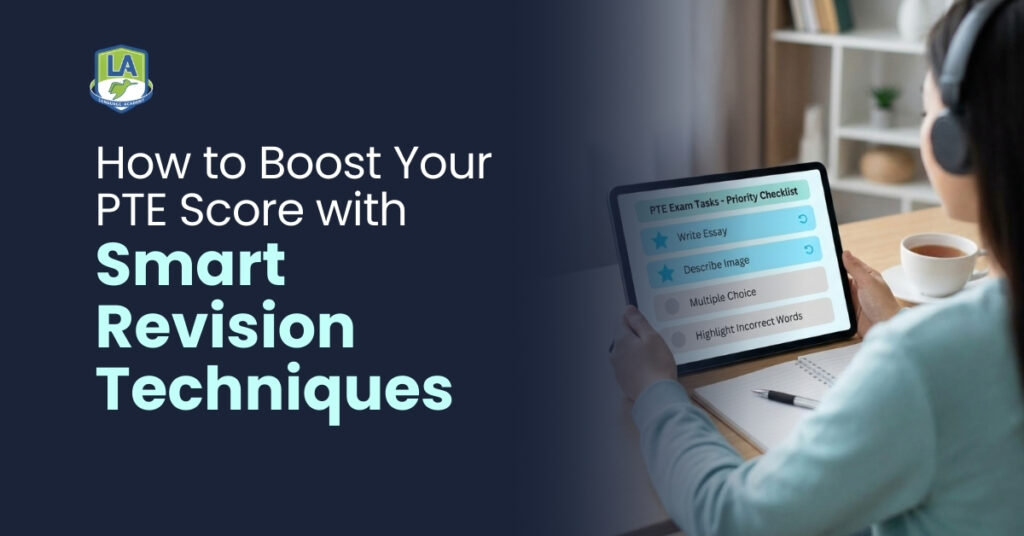
Many PTE aspirants practise daily but still struggle to move beyond a certain score range. They repeat mock tests, watch random videos, and revise everything equally, yet the score does not improve. Students who successfully boosted their PTE score did something different. They stopped revising blindly and started revising smartly. Smart revision is not about studying for more hours. It is about focusing on the right tasks, correcting scoring habits, and practising with clear intent.
This blog explains how students boosted their PTE scores using smart revision techniques and how the same approach can work for you.
What Smart Revision Really Means in PTE Preparation
Smart revision in PTE focuses on impact rather than volume. Instead of practising every task equally, students prioritise the tasks that influence multiple skills and revise based on feedback, not guesswork.
Start Your PTE Success Journey
This approach works because PTE is an AI-scored exam. The scoring system rewards stability, clarity, and consistency more than advanced vocabulary or complex ideas. When revision is aligned with scoring logic, even small improvements can lead to noticeable score jumps.
How Smart Revision Differs from Traditional PTE Practice
Traditional practice often looks busy but produces slow results. Students practise many tasks without understanding why mistakes happen. Smart revision, on the other hand, is structured and corrective.
Students following smart revision:
Confused About PTE Prep? Let’s Help!
- Identify which tasks are pulling their score down.
- Analyse mistakes instead of repeating the same errors.
- Revise based on scoring patterns, not assumptions.
- Protect time for high-impact tasks.
This shift alone helps students use their preparation time more effectively.
High-Impact PTE Tasks Students Focused on to Boost Scores Faster
One major reason students boosted their PTE score faster was task prioritisation. They understood that not all tasks carry equal weight in scoring.
Speaking Tasks That Influenced Multiple Sections
Read Aloud and Repeat Sentence played a critical role in score improvement. These tasks impact speaking, reading, and listening scores together. Students focused on fluency and rhythm rather than perfect pronunciation. They avoided long pauses and never stopped mid-sentence to correct mistakes. Even when a word was missed, they continued speaking to protect fluency.
Writing and Listening Tasks That Lifted Overall Scores
Write From Dictation was treated as a priority task because it strongly influences both listening and writing scores. Students practised dictation daily, focusing on spelling accuracy and correct word order. Summarize Written Text was handled with discipline. Students followed the one-sentence rule, kept the summary within a safe word range, and focused on grammar control rather than length or complexity.
Reading Tasks Where Smart Time Allocation Made the Difference
Reading Fill-in-the-Blanks received more revision time because it tests vocabulary, grammar, and collocations. Reorder Paragraphs was solved using logic and sentence connections rather than trial and error. Multiple-choice questions were answered quickly. If the answer was not clear within a short time, students guessed and moved on to protect time for higher-impact tasks.
Smart Revision Techniques Students Used Between Mock Tests
Boosting a PTE score does not happen during the mock test itself. It happens in the revision that follows.
Error Analysis Instead of Repetition
After each mock test, students carefully reviewed their mistakes. They did not just note the wrong answer. They focused on why the mistake occurred.
For example, if a fill-in-the-blanks answer was incorrect, they checked whether the issue was vocabulary, collocation, or grammar. In speaking tasks, they identified pauses, restarts, and pronunciation problems.
This analysis helped them avoid repeating the same mistakes in the next test.
Building a Personal Mistake Bank
Students maintained a simple mistake bank. It included only recurring errors, not one-time slips. This allowed them to revise weak areas daily in short sessions instead of revising everything again.
Even fixing three or four repeated mistakes often led to a noticeable improvement in score.
Time-Based Revision Rules That Prevented Score Drops
Time management was not only about the exam. It was also part of smart revision.
Task-Wise Time Boundaries Students Followed
Students followed clear time limits while practising:
- Reading Fill-in-the-Blanks was practised under strict time limits.
- Reorder Paragraphs was solved quickly using logical pairs.
- Speaking tasks were practised with full recordings, without stopping early.
These rules trained students to perform confidently under real exam pressure.
When to Guess and Move On
Students avoided spending too much time on tasks with lower-scoring impact or partial negative marking. If unsure, they made a calculated guess and moved forward. This habit protected time for tasks that mattered more.
Practice Habits That Helped Students Stay Consistent
Consistency played a major role in improving the score.
Short Daily Practice vs Long Irregular Sessions
Students who boosted their scores practised daily in focused sessions rather than studying for long hours occasionally. Short, consistent practice helped build fluency and reduce exam anxiety.
Simulating Real Test Conditions
Practice was done using headphones, correct microphone placement, and timed conditions. Some students even practised in low-noise environments to prepare for test centre conditions.
This reduced surprises on exam day and improved confidence.
How Structured Guidance Supports Smarter PTE Revision
At a certain point, self-practice reaches a plateau. Many students found that guided revision helped them break that barrier.
Why Feedback-Led Revision Accelerates Improvement
Feedback helps identify habits that reduce AI scores, such as hesitation, inconsistent pace, or spelling errors. With proper feedback, students knew exactly what to fix rather than guess.
How Language Academy Supports Smart PTE Revision?
Language Academy provides structured support for smart PTE revision through:
- Diagnostic mock tests that identify weak scoring areas.
- Detailed performance analytics.
- One-on-one feedback from experienced trainers.
- Portal-based practice aligned with the real PTE exam format.
- Coaching support for both PTE and NAATI CCL preparation.
This structure helps students focus on correction rather than just practice.
Outcomes Achieved Through Smart Revision at Language Academy
Students who followed a smart revision approach at Language Academy consistently achieved measurable improvements across PTE modules. Instead of relying on guesswork or repeated practice, their preparation focused on correcting scoring behaviours and strengthening high-impact tasks.
Common outcomes achieved through this process include:
- Moving from mid-range scores to target bands such as 79+ or 85+ within planned preparation cycles.
- Improved Speaking fluency with fewer pauses and higher pronunciation stability.
- Stronger Listening and Writing scores driven by accuracy in Write From Dictation and Summarize Written Text.
- Reduced score fluctuation across mock tests and the final exam.
- Successful clearance of NAATI CCL requirements alongside PTE preparation for migration goals.
These outcomes were achieved by combining task-wise prioritisation, detailed mock-test analysis, and consistent feedback, rather than by increasing study hours.
A Simple Smart Revision Checklist to Boost Your PTE Score
Use this checklist to align your revision with what works:
- Prioritise high-impact PTE tasks first.
- Analyse each mock test instead of blindly repeating.
- Track repeated mistakes and revise them daily.
- Protect fluency and avoid self-correction while speaking.
- Follow task-specific time limits during practice.
- Use structured feedback to correct scoring habits early.
Ready to Improve Your PTE Score with Smarter Revision?

Boosting your PTE score becomes achievable when revision is focused, structured, and aligned with scoring logic. Smart revision helps you improve faster without unnecessary stress or wasted effort. If you want guided preparation, targeted feedback, and structured practice support, Language Academy offers PTE coaching and mock test solutions designed for learners in Australia.
Register for a new account and get free mock test material to understand your current level, so you can plan your preparation with clarity.

The Language Academy is made up of experienced educators and language specialists dedicated to helping learners build confidence in communication. With a practical, student-focused approach, we share insights, tips, and resources designed to make language learning effective, engaging, and accessible for students at every level.