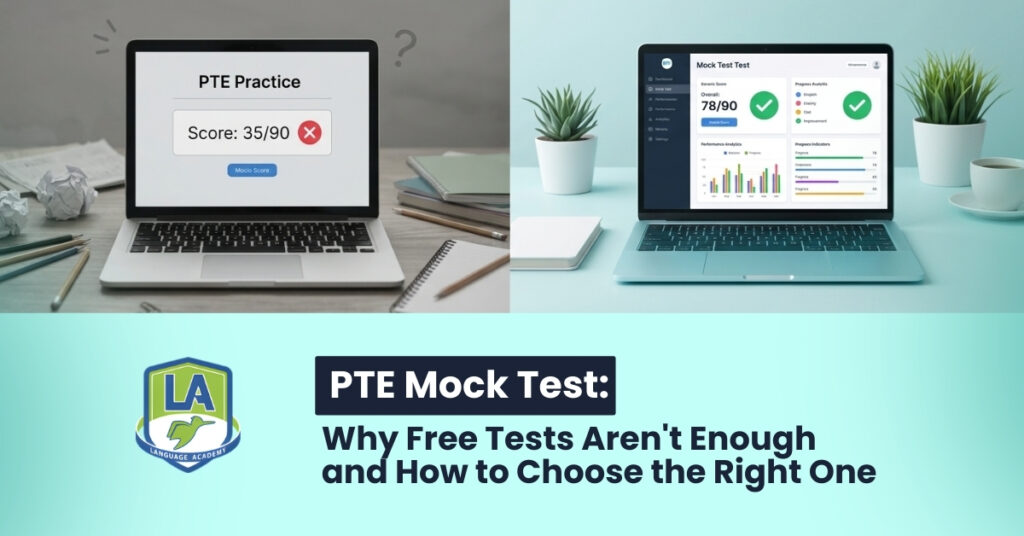
You scored 72 on your free PTE mock test. You felt ready. You sat the actual exam.
And then you saw your real score.
It happens more often than you’d think. Students across Australia, India, Nepal, and dozens of other countries walk into PTE Academic genuinely believing they were prepared — because a free online mock told them they were. The score they got at home and the score Pearson gave them on exam day didn’t even come close to matching.
Start Your PTE Success Journey
That gap isn’t bad luck. It’s a structural problem with how most free PTE practice tests are built.
This guide breaks down exactly what’s wrong with the majority of free PTE mock tests available online, what a proper mock test actually needs to include in 2026, and how to find one that gives you honest, useful results before exam day — not false confidence.
Why Students Default to Free PTE Mock Tests (And Why That’s Completely Reasonable)
PTE Academic isn’t cheap. The exam fee alone runs into hundreds of dollars. Add coaching, study materials, and living costs, and it becomes a genuine financial commitment — especially for students preparing while managing work, visa timelines, or family responsibilities.
Confused About PTE Prep? Let’s Help!
So when you search free PTE mock test online and find dozens of results claiming to simulate the real exam at zero cost, it makes complete sense to start there.
The problem isn’t that you chose a free test. The problem is that most of those free tests were never designed to actually replicate PTE Academic. They were designed to attract traffic.
The 4 Core Problems With Most Free PTE Mock Tests
1. The Scoring Is Not Pearson-Aligned
This is the biggest one, and it catches students off guard every time.
PTE Academic uses a highly specific AI scoring engine developed by Pearson. It evaluates pronunciation, fluency, content accuracy, grammar, vocabulary range, and more — using rubrics that aren’t publicly documented in full detail. The scoring for Speaking tasks like Read Aloud or Repeat Sentence, for instance, analyses your oral fluency and pronunciation at a granular phonetic level.
Most free mock platforms use their own custom scoring logic — or worse, simple rule-based scripts that check surface-level features. A platform might give you 70 for your essay when Pearson’s engine would give you 58. That 12-point gap on a writing task can be the difference between a visa approval and a re-sit.
If the scoring isn’t calibrated against actual PTE exam outcomes, the number at the end means nothing.
2. The Interface Looks Nothing Like the Real Exam
Familiarity with the exam environment matters more than most students realise.
On exam day, you won’t have time to figure out how the microphone activates for Repeat Sentence, or where the word count appears in the essay box, or how the drag-and-drop re-order paragraphs task works. If you’ve only ever practised on a platform that looks and behaves differently from Pearson’s actual test delivery interface, you will lose time — and marks — just orienting yourself.
Many free platforms present PTE questions in simplified web layouts that bear no resemblance to the real testing environment. The timer behaviour is different. The navigation structure is different. The question format is different. You’re essentially practising for an exam that doesn’t exist.
3. Feedback Is Generalised — Not Actionable
“Your fluency needs improvement.”
That’s the kind of feedback you get on most free PTE tests. It tells you something is wrong, but not what, not why, and not how to fix it.
Feedback like this feels helpful at a glance, but in practice it creates a loop. You practise more. You get the same vague feedback. Your score doesn’t move. You don’t know what to change because nobody told you.
What actually helps a student improve is specific feedback. Which word did you mispronounce? What pattern of grammar error is recurring across your writing tasks? Where exactly did your fluency break down in your Retell Lecture response? Without that level of detail, mock tests become repetition without learning.
4. Questions Are Outdated or Off-Format
PTE Academic regularly updates its question bank, and Pearson has introduced adjustments to task types, timing, and scoring weights over the years. The 2026 exam is not identical to the 2022 exam.
Many free platforms haven’t updated their question banks to reflect these changes. Some still include task types that have been retired or modified. Others use incorrectly timed sections, wrong word limits for essays, or prompts that don’t match the style of actual exam questions.
If you’re drilling questions that don’t reflect what Pearson will actually ask you, you are practising the wrong thing.
What a Proper PTE Mock Test Must Include in 2026
Before you sit any mock test — free or paid — run it through this checklist:
| Pearson-Aligned Scoring
Does the platform calibrate its scores against real PTE outcomes? Can you see your Overall, Communicative, and Enabling Skills scores broken down the same way Pearson does? Exam-Identical Interface Does the platform replicate the actual test delivery interface — including timers, microphone activation, navigation behaviour, and task formatting? Full Timed Test Conditions Can you complete a full timed mock under realistic exam conditions, not just individual questions in an untimed environment? Section-Wise and Task-Wise Score Breakdown Are you getting a score for each section and each task type? Do you know whether it’s your Speaking or Writing pulling your Overall Score down? Specific, Actionable Feedback Does the feedback tell you exactly what went wrong and how to fix it — or does it give you generic labels? Up-to-Date Question Bank Are the questions current and reflective of what Pearson is actually testing in 2026? If a free mock test can’t answer yes to most of those, it’s giving you data you can’t trust. |
How to Choose the Right PTE Mock Test Platform
Here’s the framework we recommend based on over eight years of working with PTE candidates at every level:
Start with one free scored mock — but choose it carefully
Not all free options are equal. A well-built free mock test, even if limited to one attempt, can give you a genuine baseline score and identify your weakest sections. The key is making sure the scoring is reliable.
Look for AI-driven feedback, not template feedback
Platforms that use genuine AI to evaluate your responses — especially for Speaking tasks — will give you far more useful information than those using rigid rule-based scripts. The feedback should feel personalised, not like it was copied from a rubric sheet.
Check if the interface matches Pearson’s
Before committing to practising on a platform, spend five minutes on the actual Pearson demo if you haven’t already. Then compare. If the platform you’re considering looks significantly different, consider whether that difference will cost you on exam day.
Don’t over-rely on mock scores early in your prep
A mock test taken in Week 1 of preparation is not a prediction. It’s a diagnostic. Use the score to identify gaps, not to decide whether you’re ready to book.
Prioritise regular, scored practice over volume of untimed drills
Ten random Repeat Sentence recordings with no score mean less than two properly-scored, AI-evaluated attempts with detailed feedback. Quality of feedback drives improvement faster than quantity of attempts.
Why Language Academy’s Mock Test Is Built Differently
Language Academy’s PTE mock test wasn’t built overnight, and it wasn’t built to look impressive on a website. It was built over eight years of continuous research, outcome tracking, and scoring alignment — informed directly by working with over 50,000 students preparing for PTE Academic, PTE Core, and related tests.
| The interface mirrors the real exam.
When you sit Language Academy’s mock test, the environment you’re practising in is designed to match the actual Pearson testing experience — so there’s no adjustment period on exam day. Scoring is highly Pearson-aligned. The platform scores your responses across all four skills the same way Pearson does — breaking down your Overall Score, Communicative Skills, and Enabling Skills so you know exactly where you stand. AI feedback is specific, not generic. Instead of telling you “your fluency needs work,” the platform identifies precisely where in your response the issue occurred and what type of correction is needed. That’s the difference between knowing you have a problem and knowing how to fix it. Both free and full mock tests are available. You can start with a free mock test to get a real baseline score, then move into the full portal for ongoing section-wise practice, scored attempts, and preparation that adapts to your weak points. The score you get here is meant to be a genuine reflection of where you’re at — not a number designed to make you feel good about a product. |
How Many Mock Tests Should You Do Before PTE?
There’s no single right answer, but here’s a practical guideline based on where most students start:
| Score Range | Recommended Approach |
| Below 50 | Focus on foundational skills first. Use 1–2 diagnostics to identify major gaps, then work on targeted practice before taking full mocks. |
| 50 – 65 | Take a full mock every 1–2 weeks. Review your feedback thoroughly between attempts. Targeted drilling on weak task types fills the gaps between mocks. |
| 65 – 75 | Weekly mocks under full timed conditions. At this level, exam stamina and consistency matter as much as skills. |
| 75+ | Two or three full mocks in your final two weeks, focused on maintaining accuracy under pressure and fine-tuning time management. |
Mock tests are only as useful as the review you do after them. A score alone tells you almost nothing. The breakdown, the task-level detail, and the feedback are where the learning happens.
The Bottom Line
Free PTE mock tests are a starting point, not a preparation strategy.
If the platform you’re using can’t tell you exactly why you lost marks, can’t replicate the real exam environment, and can’t give you a score that reflects what Pearson’s AI would actually give you — then you’re practising in the dark.
The right mock test doesn’t just measure where you are. It shows you how to get where you need to be.
| Ready to Find Out Your Real PTE Score?
Take Language Academy’s free PTE mock test inside the student portal — built on 8 years of research, Pearson-aligned scoring, and AI-driven feedback that actually tells you what to fix |

FAQ’s
Q1: Is a free PTE mock test accurate?
It depends entirely on the platform. Most free mock tests use custom scoring that isn’t calibrated against Pearson’s actual AI engine, which means the score you receive may be significantly different from your real exam result. Look for platforms that demonstrate Pearson-aligned scoring and have a track record with real students.
Q2: Which PTE mock test is closest to the real exam?
The closest mock tests are those that replicate the actual Pearson exam interface, use timed conditions across all sections, and provide section-wise and task-wise score breakdowns aligned with PTE’s Official Score Report format. Language Academy’s mock test is designed with these criteria at its core.
Q3: How many mock tests should I do before PTE?
It depends on your current score level, but as a general guide: if you’re scoring below 65, focus on one mock test every one to two weeks alongside targeted practice. If you’re close to your target score, two or three timed full mocks in your final two weeks helps build exam-day consistency.
Q4: Can I practice PTE online for free?
Yes. Language Academy offers a free PTE mock test inside its student portal, with Pearson-aligned scoring, section-wise breakdown, and AI feedback. You can register and access it without a credit card.
Q5: What score should I get on a PTE mock test before booking the real exam?
A general rule is to consistently score five to eight points above your target score on a reliable mock test before booking. This buffer accounts for the pressure of exam-day conditions and ensures your performance is consistent, not a one-off result.
Q6: Does PTE mock test practice actually improve your score?
Yes — but only when combined with quality feedback. Mock tests alone won’t move your score. What improves your score is identifying exactly where you lost marks, understanding why, and addressing those specific patterns through targeted practice before your next attempt.

The Language Academy is made up of experienced educators and language specialists dedicated to helping learners build confidence in communication. With a practical, student-focused approach, we share insights, tips, and resources designed to make language learning effective, engaging, and accessible for students at every level.